In a hot and steamy basement loud music was playing, flashing lights and people dancing, but this was not a disco in the modern sense but a meeting of traditional musicians playing traditional music from Zamora. The music switched from dulzainas and gaita sanabresa, after a session of gaitas a man passed and said in a loud joking frustrating voice "gaitas! gaitas!"
i took him to mean the frustration of playing together and not being in tune with one another. Not that the dancers minded they were following the rhythms of the drums and castanets but melodies help and when it sounds out of tune it can be a bit hard on the ears! Dam Bach and Mozart...and all the others who have accustomed our ears to perfect harmonies. I think traditional music is one of the remaining forms what do not require perfect harmonic intervals...but it is changing and it is changing fast.
There was something primeval, organic and alive about this performance. Yes it was all out of tune with each other but after sometime the ears and the brain got accustomed to the it and melodies were still recognized. I remember during my M.A. an article about Bulgarian female singers who sang in a few isolated valleys sang with seconds...two notes sung as harmonies but not 'harmonically in tune' with each other eg. G and A.
The gaita players where playing the same notes but the pipes were micro-tonally out of tune with each other thus creating discordant pitches, as well as drones which where not in tune with the chanter nor the other drones. It was an amazing sound, loud, rhythmic, free-making. People were enjoying it, dancing to it and even I had a go...
I think the best instrument to annoy 'harmonic music lovers' is to play the Highland Bagpipes...they are very loud and can annoy listeners quite easy (as it did with my family relations), but there is something wonderful about it too.
As far as I can tell there is no fixed tuning or pitch with the gaita Sanabresa, it is an old instrument going back to Medieval time and possibly beyond, it has that feel about it. It does not have an equal-tempered scale. It plays in a minor scale but the 3rd flattened note is not exactly a 3rd, it is a little flat and so is the 6th note it is a little flat. It would be dificult to play with other modern instruments as they would be in tuned with an equal-tempered scale so they 'fit' harmonically and fixed to a certain pitch. But it makes sense when you play the drone as it would fit in perfectly with the harmonics of the drone.
Gaita Sanabresa can be found in a Bb, B, or C and perhaps other keys in between too!
This also complicates things when one tries to notate the music. As it is in a minor scale key signatures are used in the notation. C/Do minor has 3 flats, but the chanter has a sharpened 7th note, so the Bb would actually sound a B, but it is written without accidentals or a natural sign in the key signature.
The notation is only there for reference it seems not an accurate attempts to represent pitch of the music. There is some notation that is written with out any key signature at all thus making it a C major...but the chanter is the same as before it does not play in a different key with sharps and flats like the Galician (not that i can tell anyways). So the notation is only there as a reference.
On the internet I have tried to find a scale of the gaita Sanabresa written down but I was not able to find one.
So since I could not find a series of notes describing the scale I am going to attempt one now just to put something out there for people to see:
Starting from the bottom note with all fingers closed b, C, D, Eb (flattened), F, G, Ab (flattened), B, C
If any players can add to this I would be most grateful.
Web Page and Blog of: Ethnomusicology, Music making, Instrument making, Bagpipes, Ney Flutes, Workshops, Activities...
Wednesday, May 2, 2012
Plastic Reeds
Yesterday I got tired of sitting in front of the computer and decided to give reed making a go. I had bought some tools from the local hardware store...files, sandpaper, pliers, etc. and I have had cane drying drying underneath the couch since last year. I thought to start making bagpipe reeds by using a book I had been given on how to make Northumbrian Small Pipe reeds by Colin Ross. This book was given to me by a reed maker from Appleby in Cumbria, UK. not too far from where I live. I met Bill while I was busking one day in Carlisle and through this contact I later met him in his home where he showed me his workshop, give me some tools and materials and sent me away telling me to go and make reeds, as he was stopping making. I did not do anything for a year, but now I have the time I will try it.
For this experiment I would not use the cane underneath my couch, I would use plastic so if i make a mess I can easily start again. The plastic came from a yoghurt carton and after cutting it to the specified measurements and fixed it to the metal staple I blew into it. It works, it is not loud, I need to experiment a bit with it, add a bridle, scrap it, etc. but it sounds and seems to be the right shape.
There is now a tradition of making plastic reeds. I am in favor of them, as a musician you need that stability these days. The cane reeds are great if they work well but when using your breath to play the bagpipe the moisture can cause all sorts of problems. Plastic reeds last, and it is possible to get a nice sounding reed especially if you learn to make them yourself.
Of course cane reeds sound excellent and if you are into the tradition then they are the right reed for you, but I feel if you are trying to make a living by using cane reeds then you need a steady supply of good reeds and this is not always possible to get on demand from busy pipe makers.
Bellows blown pipes are less of a problem of course due to the dry air from the bellows, but humidity is a problem with the NSP and I have played countless times...or not played, due to the reed closing, changing, getting weak and altering pitch to such an extent that I had to stop playing. This can not be a factor if one is playing for ones living. On the streets it is wet and hot, cold and windy...I am tired of playing in the shadows all the time when it is warm.
So a stable reed is important and I am quite sure if the traditional pipers from centuries ago could have had a plastic reed I am sure they would have used it.
For this experiment I would not use the cane underneath my couch, I would use plastic so if i make a mess I can easily start again. The plastic came from a yoghurt carton and after cutting it to the specified measurements and fixed it to the metal staple I blew into it. It works, it is not loud, I need to experiment a bit with it, add a bridle, scrap it, etc. but it sounds and seems to be the right shape.
There is now a tradition of making plastic reeds. I am in favor of them, as a musician you need that stability these days. The cane reeds are great if they work well but when using your breath to play the bagpipe the moisture can cause all sorts of problems. Plastic reeds last, and it is possible to get a nice sounding reed especially if you learn to make them yourself.
Of course cane reeds sound excellent and if you are into the tradition then they are the right reed for you, but I feel if you are trying to make a living by using cane reeds then you need a steady supply of good reeds and this is not always possible to get on demand from busy pipe makers.
Bellows blown pipes are less of a problem of course due to the dry air from the bellows, but humidity is a problem with the NSP and I have played countless times...or not played, due to the reed closing, changing, getting weak and altering pitch to such an extent that I had to stop playing. This can not be a factor if one is playing for ones living. On the streets it is wet and hot, cold and windy...I am tired of playing in the shadows all the time when it is warm.
So a stable reed is important and I am quite sure if the traditional pipers from centuries ago could have had a plastic reed I am sure they would have used it.
Casa de Zamora (Madrid)
Links and more links...all are connected so they say. Who would know it but last year a folklorist and music researcher I had met on Facebook called Alberto advised me to go to 'Casa de Zamora' in Madrid if I wanted to learn about bagpipes from the area of Zamora (Gaita Sanabresa) in north western Spain and to meet musicians in the Madrid area. Casa de Zamora is like a cultural centre for people from the Zamora district of Spain. Each region of Spain seems to have these cultural centers in Madrid and elsewhere, often music is practiced in these centers.
It took me a few more months to finally get round to going and this was due to meeting Alberto in Zamora and listening to his music which finally made me go; I was thrilled by the music and the musical atmosphere in Zamora. The events itself that inspired me I will write about another time, but let me say it was a new experience and it excited me so much to try and learn the Gaita Sanabresa; the Casa de Zamora’s web site (casadezamora.com) listed a gaita class on Wednesdays and last night I went along.

I noted 12 musicians (10 pipers and 2 drummers) and 1 teacher. The gaitas were not all uniform like the gaitas from Asturius or Galicia they were a mixtures of colours, textures, thicknesses and designs. There were a few new surprises such as the wood used to make a couple of chanters, they were made from a heather plant, which for me was a surprise as I know heather in Scotland and it is a small thin plant, but apparently it grows very high here and strong enough to make chanters. I also noticed there were differences in construction. This is partly due to a lack of supply, one maker was mentioned who made good pipes in Cantabria had a waiting list of about 1 year, but he made other types of pipes besides Gaita Sanabresa.

If I wanted to learn to play I was advised to get a Galician chanter in Bb (Si bemol) and tape over a section of the 3rd hole making it a minor scale (the popular key of the class was Bb and this was good for singing). The tuning of the chanter was still unclear to me but generally the Sanabresa chanters have a flattened 3rd note and a flattened 6th note, but this was not always the case; and Aliste chanters (the region just south of Sanabresa) had the 3rd note flattened and the 6th note natural. There still needs some clarification in my mind about all of this. The Galician chanters in the class were thinner and slender than the Sanabresa, one boy had quite a thick Sanabresa chanter; their melodies were 1 octave and they used open fingering. The tone was not harsh and with 10 pipers in a small room it was OK on the ears, and time was spent tuning and making sure the pipes were playing in tune together.

Another point of note was the bag construction, the people who had bought Galician gaitas (so they could learn quickly) had a Galician/Asturian style of bag - 'pear shaped' in style made from Gortex, with the bag cut so the drone stock sits naturally onto the shoulder. The Sanabresa gaita bags had the form of an animal and the drone stock was one of its legs (I do not think an animal skin was used, but the shape of the bag was constructed to look like one) and this 'bent' backwards so the drone went over the shoulder. Some had tassel's over the drones others with out.

The drones were thick and differently designed made from different types of wood: 'black wood' and 'red wood', 'knotted wood' and 'heather wood' some of the drone sections had metal rings around the ends as did some of the chanters.
Men and women were learning to play all with different standards, they used notation sometimes but the people seemed to know the melodies from growing up in the Zamora region and were able to play from memory. There were 2 drummers and the rhythms were fast sometimes in 5/8 (aksak rhythm) and other times in more regular patterns, often the rhythm changed half way through a melody from 3/4 to 6/8; often the teacher took the drum when they played as a ensemble.
I was impressed by the whole evening, their friendliness and their music, which I liked a lot.
I will give it a try,...
It took me a few more months to finally get round to going and this was due to meeting Alberto in Zamora and listening to his music which finally made me go; I was thrilled by the music and the musical atmosphere in Zamora. The events itself that inspired me I will write about another time, but let me say it was a new experience and it excited me so much to try and learn the Gaita Sanabresa; the Casa de Zamora’s web site (casadezamora.com) listed a gaita class on Wednesdays and last night I went along.
I noted 12 musicians (10 pipers and 2 drummers) and 1 teacher. The gaitas were not all uniform like the gaitas from Asturius or Galicia they were a mixtures of colours, textures, thicknesses and designs. There were a few new surprises such as the wood used to make a couple of chanters, they were made from a heather plant, which for me was a surprise as I know heather in Scotland and it is a small thin plant, but apparently it grows very high here and strong enough to make chanters. I also noticed there were differences in construction. This is partly due to a lack of supply, one maker was mentioned who made good pipes in Cantabria had a waiting list of about 1 year, but he made other types of pipes besides Gaita Sanabresa.
If I wanted to learn to play I was advised to get a Galician chanter in Bb (Si bemol) and tape over a section of the 3rd hole making it a minor scale (the popular key of the class was Bb and this was good for singing). The tuning of the chanter was still unclear to me but generally the Sanabresa chanters have a flattened 3rd note and a flattened 6th note, but this was not always the case; and Aliste chanters (the region just south of Sanabresa) had the 3rd note flattened and the 6th note natural. There still needs some clarification in my mind about all of this. The Galician chanters in the class were thinner and slender than the Sanabresa, one boy had quite a thick Sanabresa chanter; their melodies were 1 octave and they used open fingering. The tone was not harsh and with 10 pipers in a small room it was OK on the ears, and time was spent tuning and making sure the pipes were playing in tune together.
Another point of note was the bag construction, the people who had bought Galician gaitas (so they could learn quickly) had a Galician/Asturian style of bag - 'pear shaped' in style made from Gortex, with the bag cut so the drone stock sits naturally onto the shoulder. The Sanabresa gaita bags had the form of an animal and the drone stock was one of its legs (I do not think an animal skin was used, but the shape of the bag was constructed to look like one) and this 'bent' backwards so the drone went over the shoulder. Some had tassel's over the drones others with out.
The drones were thick and differently designed made from different types of wood: 'black wood' and 'red wood', 'knotted wood' and 'heather wood' some of the drone sections had metal rings around the ends as did some of the chanters.
Men and women were learning to play all with different standards, they used notation sometimes but the people seemed to know the melodies from growing up in the Zamora region and were able to play from memory. There were 2 drummers and the rhythms were fast sometimes in 5/8 (aksak rhythm) and other times in more regular patterns, often the rhythm changed half way through a melody from 3/4 to 6/8; often the teacher took the drum when they played as a ensemble.
I was impressed by the whole evening, their friendliness and their music, which I liked a lot.
I will give it a try,...
On Stage in Zamora (Spain)
It has been a number of years since I stood on stage alone playing solo. I remembered when I last did it back in the 90s on stage in Vilnius, Lithuania. I have played countless time since then but to stand on stage in front of about 400 people is still a nerve racking event. Playing with others is easier, you follow each other, timing is easier and just to be with another is more relaxing. I have played Border Pipes for years but hardly performed with them on stage and I choose to start the concert with them. My nerves showed for the first set of tunes, but after a while I got used to it and relaxed. When I played the Northumbrian Small Pipes I was back on familiar territory and played my set with out too much trouble.
I do not think it is the 'standing on stage' that is the problem with nerves it is the microphones, it can be in a room with friends or solo recording a CD, but whenever I stand in front of a microphone I grow tense, I do not play as I normal; I can not move or walk around. The microphone rivets me to a spot...curse it.
The melodies I played for the Border pipes (BP) were:
Frisky,
Chevy Chase,
I'm O'er Young to Marry Yet,
Bonny Lad.
Except for Chevy Chase, which is a Border Ballad, the rest of the tunes can be found in the Peacock manuscript from the early 1800s.
Frisky,
Chevy Chase,
I'm O'er Young to Marry Yet,
Bonny Lad.
Except for Chevy Chase, which is a Border Ballad, the rest of the tunes can be found in the Peacock manuscript from the early 1800s.
The next tune I played was Bonny Pit Laddie, also from Peacock, and I played as many variations as I could remember (I think I missed one out). The style of the Northumbrian and (Scottish) Border repertoire is full of melodies with variations and to memorize them is quite a task; I fail each time but I must say I am also getting better at it too, as my playing time increases so is my memory for these variations.
Next, there was a quick change over of instruments from BP to Northumbrian Small Pipes (NSP). These are quicker to tune than the BP and less problematic to hold and to play. The melodies I played were:
Mallorca,
Wards Brae,
Gallowgate Lass.
The last two melodies I grouped together into one melody as they are very similar to each other.
The final group of tunes were:
Johnny Armstrong
Welcome to the Town Again,
the first being a Border Ballad melody and the last a dance tune from Peacocks.
The experience was an interesting one, enjoyable and I hope the start of many more to come in the future.
The video is of the first performance on NSP.
Next, there was a quick change over of instruments from BP to Northumbrian Small Pipes (NSP). These are quicker to tune than the BP and less problematic to hold and to play. The melodies I played were:
Mallorca,
Wards Brae,
Gallowgate Lass.
The last two melodies I grouped together into one melody as they are very similar to each other.
The final group of tunes were:
Johnny Armstrong
Welcome to the Town Again,
the first being a Border Ballad melody and the last a dance tune from Peacocks.
The experience was an interesting one, enjoyable and I hope the start of many more to come in the future.
The video is of the first performance on NSP.
Labels:
Bagpipes,
Border Pipes,
Music,
Music in Spain,
Northumbrian Small Pipes
Sac de Gemcs and Galician Bagpipes
I am playing and practicing more Spanish melodies than I am Northumbrian melodies at the moment. Being in the UK allows me to play as much as I want with out bothering anyone. I am getting used to the Sac de Gemecs (bagpipe from Catalonia) as I had problems with its tuning. Again the original reed was not making the chanter in tune with the drones. My recent visit to Madrid produced a Galician reed in C, and when I returned to the UK I fitted it to the Sac de Gemecs and it is sounding nice and in tune with itself. I can also put more pressure on the bag to keep the drone pressure right. In short, it is a easier and nice bagpipe to play now.
I am also playing my Galician D chanter a lot in my 'hybrid' bagpipe. It is sounding sweet, a high pitched sound and beautifully in tune with the drones. I am practicing Catalonian and Galician melodies on this and as the fingering is nearly identical I can transfer them onto the Sac de Gemecs.
I finished a composition of a Catalonian melody played on the Sac de Gemecs called "L'arrastrat". I used the English Concertina as a 1st and 2nd voice along side the Sac de Gemecs melody. I did the recording in the UK and later added the Concertina track in Spain. Have a listen ...
I am also playing my Galician D chanter a lot in my 'hybrid' bagpipe. It is sounding sweet, a high pitched sound and beautifully in tune with the drones. I am practicing Catalonian and Galician melodies on this and as the fingering is nearly identical I can transfer them onto the Sac de Gemecs.
I finished a composition of a Catalonian melody played on the Sac de Gemecs called "L'arrastrat". I used the English Concertina as a 1st and 2nd voice along side the Sac de Gemecs melody. I did the recording in the UK and later added the Concertina track in Spain. Have a listen ...
Labels:
Bagpipes,
Galician Gaita,
Music,
Music in Spain,
Sac de Gemecs
Northumbrian Small Pipe 1st Tune Book
A friend recently gave me a copy of the Northumbrian Small Pipes 1st tune book. I had a copy already but this one was from a charity shop in Carlisle, Cumbria. He paid 20p for it, and it was in excellent condition. It is older than my new copy indicating that is has hardly been used/played, with a nice diagram on the back cover of the Northumbrian Small Pipe chanter and the notes it produces. The price is on ‘shillings’ and on the inside it is stated that it is produced in 1970, when I was 5 years old. Inside there are the same number of tunes listed.
The Border Bagpipe Practise
In view of a forthcoming concert in Catalonia in July I connected the
Border pipe chanter into my mouth blown 'hybrid' bagpipe bag to practise
some tunes; it sounded ok after adjustments to the Galician reed. The
bottom notes sound strong and clear, but the top notes sound croaky and
not distinct. I took the glue out of the 7th hole (which made it play a
flattened 7th note) and practised cross-fingering the 7th to get the
flattened note, this allowed me to obtain a sharpened 7th with
open-fingering as some of the melodies I am learning require both notes.
I played Border tunes mainly in 9/8 a few slow airs from the "Border
Bagpipe Book", then I finished the day with melodies from Bewick and
Peacock. With the one bass drone (cane reed) sounding just over my
shoulder the chanter and the drone blended beautifully together...a joy
to play.
My "Hybrid" Mouth Blown Bagpipes
If Organology is a study of musical instruments then musical
archaeology is a piecing together of facts about a time and place of
that instrument.
My newly made bagpipe would tell of many layers of musical history, and as it stands today, a history that travels continents.
If we start with the oldest first:
The Drones, then we will find out that they came from India, the Punjab. I bought a set of Highland pipes in a small town in 1995. They cost me 18 UK pounds, with it I got several drone reeds and chanter reeds, in fact I bought what there was in his shop. I suspected the chanter would not be in tune but the rest of the pipe I could use for other things. In fact teh reeds fit well in my Border pipe too.
The 3 drones were in a rubber bag, very small, easily inflated but leaked a lot.
The blow pipe had a metal mouth piece which fell off after several years.
With all its faults it did play, and I did use this set of pipes for experiments over the years.
The pipe is made from wood, the chanter is conically bored and not dissimilar to the bore of my Border pipe.
I used the Indian Bass drone in my Hybrid Bagpipe, it plays in 'Bb' as well as in 'A' and by changing the drones around (removing the middle section) I can also play in 'D' with the same reed.
I use the cane reeds I bought in India and they are very good and reliable after so many years.
I use all stocks from the Indian bagpipe too, as well as mouth piece. I have made a few mouth piece tips to replace the metal one I lost. The 'crack value' i have replaced recently to make it more air tight.
The Bag I bought in Spain in 2011 from a shop in Madrid, it is a synthetic bag which is in a 'pear drop' design, not my favorite to hold, I think in the future I would buy/make a bag in the Highland style.
The cover was made by myself and Leila with fabric bought in Madrid and Zamora.
The Chanter/s I play are a mixture of traditions. Originally I got it to play with my Sanabresa Chanter in Bb, I turned a stock for it and connected it to the bag.
I also made a stock for my Border pipes chanter and if I tuned the drones down to 'A' I could get a good sound with the same reed
I also turned a stock for my Galician chanter in D, I removed the middle section of the Drone and it played a D drone to go with it.
The beauty of mouth blown pipes over bellows blown is the less time to 'pick up and play'; and less time in tuning the drones, also with these pipes I have been able to add a Galician reed in all of them, where as to obtain a Border reed or Sanabresa reed is quite difficult.
Another advantage with this system is that I have 3 chanters and 1 bag, which saves space when transporting them and costs a lot less to buy.
My newly made bagpipe would tell of many layers of musical history, and as it stands today, a history that travels continents.
If we start with the oldest first:
The Drones, then we will find out that they came from India, the Punjab. I bought a set of Highland pipes in a small town in 1995. They cost me 18 UK pounds, with it I got several drone reeds and chanter reeds, in fact I bought what there was in his shop. I suspected the chanter would not be in tune but the rest of the pipe I could use for other things. In fact teh reeds fit well in my Border pipe too.
The 3 drones were in a rubber bag, very small, easily inflated but leaked a lot.
The blow pipe had a metal mouth piece which fell off after several years.
With all its faults it did play, and I did use this set of pipes for experiments over the years.
The pipe is made from wood, the chanter is conically bored and not dissimilar to the bore of my Border pipe.
I used the Indian Bass drone in my Hybrid Bagpipe, it plays in 'Bb' as well as in 'A' and by changing the drones around (removing the middle section) I can also play in 'D' with the same reed.
I use the cane reeds I bought in India and they are very good and reliable after so many years.
I use all stocks from the Indian bagpipe too, as well as mouth piece. I have made a few mouth piece tips to replace the metal one I lost. The 'crack value' i have replaced recently to make it more air tight.
The Bag I bought in Spain in 2011 from a shop in Madrid, it is a synthetic bag which is in a 'pear drop' design, not my favorite to hold, I think in the future I would buy/make a bag in the Highland style.
The cover was made by myself and Leila with fabric bought in Madrid and Zamora.
The Chanter/s I play are a mixture of traditions. Originally I got it to play with my Sanabresa Chanter in Bb, I turned a stock for it and connected it to the bag.
I also made a stock for my Border pipes chanter and if I tuned the drones down to 'A' I could get a good sound with the same reed
I also turned a stock for my Galician chanter in D, I removed the middle section of the Drone and it played a D drone to go with it.
The beauty of mouth blown pipes over bellows blown is the less time to 'pick up and play'; and less time in tuning the drones, also with these pipes I have been able to add a Galician reed in all of them, where as to obtain a Border reed or Sanabresa reed is quite difficult.
Another advantage with this system is that I have 3 chanters and 1 bag, which saves space when transporting them and costs a lot less to buy.
New Melodies for the Border Pipes
I am beginning to learn new melodies on the Border Pipes for the
concert in Catalonia in July. I normally play a mixed bag of melodies
from Peacock and Bewick with a few Highland tunes as well as the occasional European melody, but now I am concentrating on music from
the Scottish and English Borders from the "O'er the Hills and Far Away"
(ohfa) and the "Dixon Manuscript" tune books, these tunes have a very different
feel to the Northumbrian as they have the flattened 7th note (a G
natural, with my A pipes), and the use of notes fall easier to the
fingers.
The melodies I am working upon now are:
"An thou were my ain thing" (Dixon)
"Green Bracken" (ohfa)
"The Lad that Keeps the Cattle" (ohfa)
"Gallowa Hills" (ohfa)
"Now Westlin Winds" (ohfa)
"Kelso Lasses" (ohfa)
"The Wedding O'Blyth" (ohfa)
"All Night I lay with Jockey in my Arms" (ohfa)
"Stool of Repentance" (Dixon)
"Dorrington Lads" (Dixon)
"Gingling Geordie" (Dixon)
The melodies I am working upon now are:
"An thou were my ain thing" (Dixon)
"Green Bracken" (ohfa)
"The Lad that Keeps the Cattle" (ohfa)
"Gallowa Hills" (ohfa)
"Now Westlin Winds" (ohfa)
"Kelso Lasses" (ohfa)
"The Wedding O'Blyth" (ohfa)
"All Night I lay with Jockey in my Arms" (ohfa)
"Stool of Repentance" (Dixon)
"Dorrington Lads" (Dixon)
"Gingling Geordie" (Dixon)
Making a Swedish Sackpipa
For about 30 years I have been trying to make a set of
bagpipes...Northumbrian, Border, Sackpipa, Labanora Duda, Musette. I have
always failed because I have never had the correct reeds, nor the
correct measurements. I am beginning again hoping I have more knowledge
this time to complete a set. I am starting with the Swedish Sakpipa as I
am hoping to go to Gagnef in Sweden in June to the Sakpipa Meeting, and
there I can ask advice about reeds and perhaps make one that will fit.
I got measurements a few years ago of the chanter and I began today making it from Damson wood that I got from my garden, it has been drying for a year.
Today I cut and turned the wood then drilled the bore of 6mm. dia. down the middle, this took me all day, a slow process.
The problem being the wood is thick and I have to turn it down, which takes quite some time.
I have a few pieces of Spanish cane (Arundo Donax) which I take to Gagnef and make the reeds. The Damson wood has a beautiful grain and it is a white colour.
I got measurements a few years ago of the chanter and I began today making it from Damson wood that I got from my garden, it has been drying for a year.
Today I cut and turned the wood then drilled the bore of 6mm. dia. down the middle, this took me all day, a slow process.
The problem being the wood is thick and I have to turn it down, which takes quite some time.
I have a few pieces of Spanish cane (Arundo Donax) which I take to Gagnef and make the reeds. The Damson wood has a beautiful grain and it is a white colour.
Making a Scottish Small Pipe Chanter
My need to play indoors in Spain requires me to have a quieter chanter that has a flattened 7th note. My Northumbrian Small Pipes have a sharpened 7th and my Border pipes have both but they are too loud for a small room with neighbors. So I bought a hard wood called "Santa Rosa" a deep red wood, beautiful colouring that slowly turns a darker colour as time passes. I began by boring the wood end to end with the lathe, and achieved nearly a perfect bore with only slight wandering of the drill bit.
Then put it in the lathe and turned it down to a workable size
| Turned piece of Santa Rosa Hardwood |
Monday, April 30, 2012
Gales, Peace and Kite Surfers
The wind was howling from the East, cold wind that made the boat stays sing. I found one of the mooring ropes snapped, it had been at a weak point.There were still 3 more warps attached and a loose chain, but it showed that Sadaf was still getting a battering at the end of April! The tide had been low barely lifting her off the sands. I spent some time fixing the warps making them as one so to add strength to the whole. I went for a walk beside the harbour and sat on the sand out of the wind. Another climate was there, warm sunshine, birds diving and singing, the lapping of the waves that were blown in by the gale, i closed my eyes and rested. Cycling home the ebbing tide was full of white-tops, wind-with-tide...just wait until it was wind-against-tide then it would be a mass of white-horses and crashing waves. I noticed a kite in the distance and nearing I saw kite-surfers bounding over the surf, it was the first time I had seen it close up, good fun!
Sunday, April 29, 2012
Making a Scottish Small Pipe Chanter
My need to play indoors in Spain requires me to have a quieter chanter that has a flattened 7th note. My Northumbrian Small Pipes have a sharpened 7th and my Border pipes have both but they are too loud for a small room with neighbours. So I bought a hard wood called "Santa Rosa" a deep red wood, beautiful colouring that slowly turns a darker colour as time passes. I began by boring the wood end to end with the lathe, and achieved nearly a perfect bore with only slight wandering of the drill bit.
Then put it in the lathe and turned it down to a workable size.
| Turned piece of Santa Rosa Hardwood |
Thursday, April 19, 2012
Single Axle Trailer
I came across a single axle trailer that belonged to a static caravan, I thought perhaps to convert it into a trailer for my Hurley Felicity. It needed some work of course, but the trailer was in good condition. It had the base of the caravan still fixed a floor of thick ply wood this would need to be removed as the sea would use it as a rudder and perhaps tilt the trailer with the fast tides races we have. There was lights connected but no jocky wheel and I was not sure about any brakes! The trailer was about 20ft the same size as the boat. In the end I decided I did not need it yet, perhaps after the sailing season is over and perhaps a single axle is not the most stable, but I think it would be good enough for pulling the boat to/from the mooring twice a year.
Tuesday, April 17, 2012
My Hybrid Bagpipes
If Organology is a study of musical instruments then musical archaeology is a piecing together of facts about a time and place of that instrument.
My newly made bagpipe would tell of many layers of musical history, and as it stands today, a history that travels continents.
If we start with the oldest first:
The Drones, then we will find out that they came from India, the Punjab. I bought a set of Highland pipes in a small town in 1995. They cost me 18 UK pounds, with it I got several drone reeds and chanter reeds, in fact I bought what there was in his shop. I suspected the chanter would not be in tune but the rest of the pipe I could use for other things. In fact teh reeds fit well in my Border pipe too.
The 3 drones were in a rubber bag, very small, easily inflated but leaked a lot.
The blow pipe had a metal mouth piece which fell off after several years.
With all its faults it did play, and I did use this set of pipes for experiments over the years.
The pipe is made from wood, the chanter is conically bored and not dissimilar to the bore of my Border pipe.
I used the Indian Bass drone in my Hybrid Bagpipe, it plays in 'Bb' as well as in 'A' and by changing the drones around (removing the middle section) I can also play in 'D' with the same reed.
I use the cane reeds I bought in India and they are very good and reliable after so many years.
I use all stocks from the Indian bagpipe too, as well as mouth piece. I have made a few mouth piece tips to replace the metal one I lost. The 'crack value' i have replaced recently to make it more air tight.
The Bag I bought in Spain in 2011 from a shop in Madrid, it is a synthetic bag which is in a 'pear drop' design, not my favourite to hold, I think in the future I would buy/make a bag in the Highland style.
The cover was made by myself and Leila with fabric bought in Madrid and Zamora.
The Chanter/s I play are a mixture of traditions. Originally I got it to play with my Sanabresa Chanter in Bb, I turned a stock for it and connected it to the bag.
I also made a stock for my Border pipes chanter and if I tuned the drones down to 'A' I could get a good sound with the same reed
I also turned a stock for my Galician chanter in D, I removed the middle section of the Drone and it played a D drone to go with it.
The beauty of mouth blown pipes over bellows blown is the less time to 'pick up and play'; and less time in tuning the drones, also with these pipes I have been able to add a Galician reed in all of them, where as to obtain a Border reed or Sanabresa reed is quite difficult.
Another advantage with this system is that I have 3 chanters and 1 bag, which saves space when transporting them and costs a lot less to buy.
My newly made bagpipe would tell of many layers of musical history, and as it stands today, a history that travels continents.
If we start with the oldest first:
The Drones, then we will find out that they came from India, the Punjab. I bought a set of Highland pipes in a small town in 1995. They cost me 18 UK pounds, with it I got several drone reeds and chanter reeds, in fact I bought what there was in his shop. I suspected the chanter would not be in tune but the rest of the pipe I could use for other things. In fact teh reeds fit well in my Border pipe too.
The 3 drones were in a rubber bag, very small, easily inflated but leaked a lot.
The blow pipe had a metal mouth piece which fell off after several years.
With all its faults it did play, and I did use this set of pipes for experiments over the years.
The pipe is made from wood, the chanter is conically bored and not dissimilar to the bore of my Border pipe.
I used the Indian Bass drone in my Hybrid Bagpipe, it plays in 'Bb' as well as in 'A' and by changing the drones around (removing the middle section) I can also play in 'D' with the same reed.
I use the cane reeds I bought in India and they are very good and reliable after so many years.
I use all stocks from the Indian bagpipe too, as well as mouth piece. I have made a few mouth piece tips to replace the metal one I lost. The 'crack value' i have replaced recently to make it more air tight.
The Bag I bought in Spain in 2011 from a shop in Madrid, it is a synthetic bag which is in a 'pear drop' design, not my favourite to hold, I think in the future I would buy/make a bag in the Highland style.
The cover was made by myself and Leila with fabric bought in Madrid and Zamora.
The Chanter/s I play are a mixture of traditions. Originally I got it to play with my Sanabresa Chanter in Bb, I turned a stock for it and connected it to the bag.
I also made a stock for my Border pipes chanter and if I tuned the drones down to 'A' I could get a good sound with the same reed
I also turned a stock for my Galician chanter in D, I removed the middle section of the Drone and it played a D drone to go with it.
The beauty of mouth blown pipes over bellows blown is the less time to 'pick up and play'; and less time in tuning the drones, also with these pipes I have been able to add a Galician reed in all of them, where as to obtain a Border reed or Sanabresa reed is quite difficult.
Another advantage with this system is that I have 3 chanters and 1 bag, which saves space when transporting them and costs a lot less to buy.
Labels:
Border Pipes,
Gaita Sanabresa,
Galician Gaita,
Spain,
UK
Monday, April 16, 2012
Hoisting the Mast Single-handed
On my 3 previous years I have had help in hoisting the mast, but this year I was alone and I was not even sure if I could do it successfully. It took me a long time to prepare the rig, halyards and stays to be connected and fitted correctly and it is amazing how quickly one forgets!
The lee shore had turned the boat so it sat on a bed of sand and with me trampling over it turned it into a quicksand..going was slow as I had to pull my boot out of the soup underneath me.
After 5 hours of of checking and rechecking the rig in case I had forgotten anything it was time to hoist the mast. I did a trial run and found that stays had lodged themselves under all manner of things, after freeing everything I connected the wooden pole/lever that I had fixed to the pivot axle where the mast rotated. This wooden pole had rope either side of it to stop it tilting too far over. The stay was fitted into a groove at the top of the pole and tied so it would not slip out. The end of the stay was tied to a rope and fed though the a pulley at the bows.
I hoisted the mast onto my shoulder and walked towards the cabin slowly edging the mast high as I walked and taking the weight with the rope. When I could not go any farther I tried to pull on the rope and hoist the mast by using the pole and stay...it did not lift due to the angle of the pole. It was vertical but the mast was not high enough.
I dismantled the rope and fitted another pulley to the stay end, so i could thread the rope through two pulleys so halving the strain on the rope. I repeated the process and when it came to the point where I could not walk any further and support the mast I pulled on the rope and the pulley system enabled me to hoist the mast vertical. It was up, I pulled tight and as it slotted into the base I threaded another bolt into the lower mast section, she was secured.
I jumped down, tightened the stays to the boat and made everything tight.
The lee shore had turned the boat so it sat on a bed of sand and with me trampling over it turned it into a quicksand..going was slow as I had to pull my boot out of the soup underneath me.
After 5 hours of of checking and rechecking the rig in case I had forgotten anything it was time to hoist the mast. I did a trial run and found that stays had lodged themselves under all manner of things, after freeing everything I connected the wooden pole/lever that I had fixed to the pivot axle where the mast rotated. This wooden pole had rope either side of it to stop it tilting too far over. The stay was fitted into a groove at the top of the pole and tied so it would not slip out. The end of the stay was tied to a rope and fed though the a pulley at the bows.
I hoisted the mast onto my shoulder and walked towards the cabin slowly edging the mast high as I walked and taking the weight with the rope. When I could not go any farther I tried to pull on the rope and hoist the mast by using the pole and stay...it did not lift due to the angle of the pole. It was vertical but the mast was not high enough.
I dismantled the rope and fitted another pulley to the stay end, so i could thread the rope through two pulleys so halving the strain on the rope. I repeated the process and when it came to the point where I could not walk any further and support the mast I pulled on the rope and the pulley system enabled me to hoist the mast vertical. It was up, I pulled tight and as it slotted into the base I threaded another bolt into the lower mast section, she was secured.
I jumped down, tightened the stays to the boat and made everything tight.
Friday, April 13, 2012
Broken Mooring Chain
As the weather improves I am preparing to put the mast up once more. I was down there today enjoying a coffee in the sun. I realised it is less of a yacht than a cottage by the sea where I can go and relax, do some maintenance and enjoy the nature. I like being there...I prefer being there.
I arrived at the boat the other day to find the mooring chain cut in two. It must have worn through with the high winds and just sheered off leaving the chain slack. Luckily, I had fastened two lengths of nylon rope just in case this happened so Sadaf as the chain was wearing thin, so it was still there and had not floated away with the tide. I have added an extra length of chain over the broken piece until I can buy a new mooring chain of about 25ft.
Wednesday, March 21, 2012
Sail on Sea Kayak
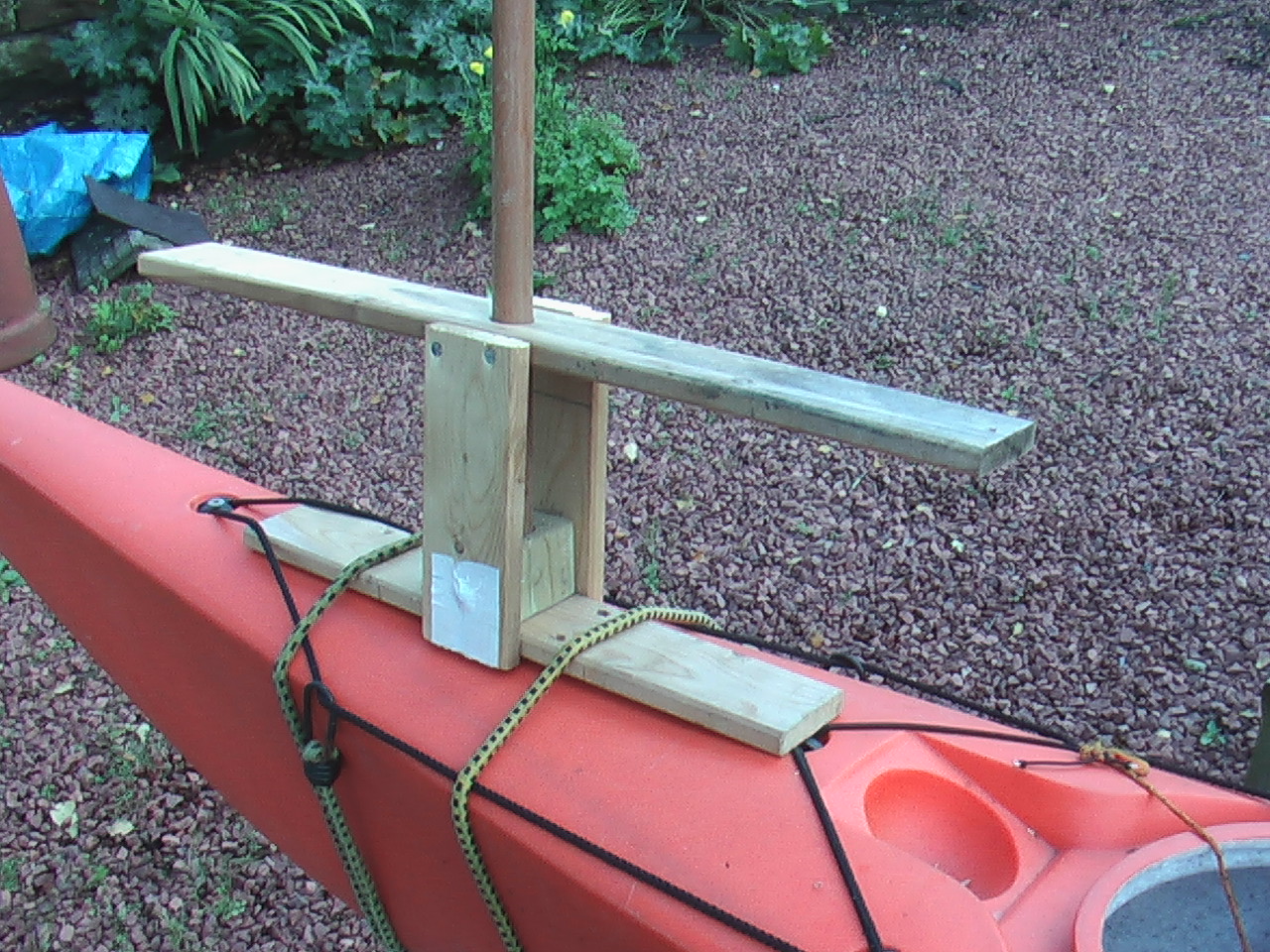
After making my new rig for my Capella Sea kayak, I set everything up in the garden to try it out in a light breeze.
The mast needed supported with bunji straps to take the strain fore and aft; also I noticed a block needed to be fixed in the center of the hull so the paddle will not hit the sheet.
The poly tarp sail is of a Bermudan style, and may need battens to help it have maximum efficiency.
In general, it worked well, probably not good to windward, but on a run, I think it will be enough to rest the arms and use the oar as a rudder. I will be using 'sponsons' either side of the cockpit for stability, and I may even fix a lee-board for upwind use.
The mast needed supported with bunji straps to take the strain fore and aft; also I noticed a block needed to be fixed in the center of the hull so the paddle will not hit the sheet.
The poly tarp sail is of a Bermudan style, and may need battens to help it have maximum efficiency.
In general, it worked well, probably not good to windward, but on a run, I think it will be enough to rest the arms and use the oar as a rudder. I will be using 'sponsons' either side of the cockpit for stability, and I may even fix a lee-board for upwind use.
Tuesday, February 7, 2012
Porto in Portugal
A recent trip to Aveiro in Portugal to attend an Organology Conference, we stayed in Porto and I was delighted in the overview of the city. Small streets line the banks of the river, an excellent river for kayaking from Spain which I will attempt later this year hopefully.
Porto has kept its old feel, small streets large enough to reach across and touch both walls.
The harbour showed a history in the stone, and boats were there now for touristy purposes, but it added to a charm of the place. The old traditional boats next to the old harbour walls.
Long oars were used to propel the boats, but they can not have been for sea voyaging on the Atlantic.
Brightly painted sterns. We did not see any sails in use, but in the summer the boats are used for transporting tourists.
Portugal is well known for its coloured tiles on the sides of houses and churches, and railways stations.
| A view from the bridge onto old Porto |
| Old Medieval Streets |
| Old Harbour |
Brightly painted sterns. We did not see any sails in use, but in the summer the boats are used for transporting tourists.
Portugal is well known for its coloured tiles on the sides of houses and churches, and railways stations.
Thursday, January 26, 2012
Gaita Pedrazales Chanter Reeds - Galician!
When I got my Gaita Pedrazales chanter 2 weeks ago it came with 2 reeds. The chanter is beautiful, made from Santo Palo wood with nice grain.
Plastic Reed:
One reed was made from plastic, very small stable and blades, but I could not get it to sound a octave, the top register was very sharp.
Cane Reed
The cane reed was very good, it played well with not to much pressure, it looked nice.
Since I had a class that evening I did not alter it to fit the chanter, I thought to leave it to my teacher to get it fitted properly.
In the class the teacher found it to be too flat. The Pedrazales chanter plays in Bb, and it was below that, not by much but enough to make the group of gaitas sound like a swarm of bees! So, there was two options, either push the reed further into the chanter by opening the wooden hole more to accommodate the reed or to cut a bit off the reed tip. Out came the knife and off came the reed tip, scraping to reduce pressure resulted in a sharpened reed, but still not in Bb, out came the knife and off came the reed, scraping and a chanter that played in Bb. "All is well that ends well" so the saying goes...not so.
When I got home I took out the reed and left it over night to dry. The next day the reed had warped a little. Central heating was the problem, but worse than this when I came to adjust the reed the binding came away too, leaving the 2 cane blades in my hands. The thread had unraveled, I do not know if this was due to the central heating system, but the thread and metal are not effected by heat generally? I will never know. The 2 reeds came from the same maker, but they seemed well constructed when I got them. I wrapped thread around the blades to try and make it play again, it did but not good enough for the Pedrazales.
So, 2 days after I got the chanter and reeds I had no reeds left to play the chanter! What a beginning.
The only thing to do was to use Scottish Highland chanter reeds. These HBG reeds are from Pakistan, some would say useless, but they are not so bad if one is not into competitions. They play and are cheap enough to play around with in Border pipe chanters etc. They play in A/La, and luckily my chanter was Bb. So out came the knife and off went the reed tip, until I had a chanter in Bb in the bottom note, but the top was sharp, out came the tape and the top notes played in tune. The pressure was wrong, too much and the drone stopped and I could not get the notes, too little and the bottom notes were "double toning" when all fingers were closed. I added thin wire so I could adjust the reed and keep it in position.
I took a trip to Madrid to see if they had reeds that would fit. They had some Pedrazales reeds, made by a maker in Madrid, the bindings on these reeds were glued, so they would not unravel and they looked good. I tried 3 of them but all 3 were sharp in the top notes, nothing worked. Then I tried the Galician gaita reeds for a Bb chanter. I put it in and blew...Bb exactly. The reed worked first time and it was made so I could move the reed in and out so making it Bb sharp...or flat. The pressure was nice, and There was no "double toning" in the bass notes. I was a happy man again.
Why do Bb Galician chanter reeds work in a Pedrazales chanter? Why does a Pedrazales reeds not work in a Pedrazales chanter? what is going on?
Plastic Reed:
One reed was made from plastic, very small stable and blades, but I could not get it to sound a octave, the top register was very sharp.
Cane Reed
The cane reed was very good, it played well with not to much pressure, it looked nice.
Since I had a class that evening I did not alter it to fit the chanter, I thought to leave it to my teacher to get it fitted properly.
In the class the teacher found it to be too flat. The Pedrazales chanter plays in Bb, and it was below that, not by much but enough to make the group of gaitas sound like a swarm of bees! So, there was two options, either push the reed further into the chanter by opening the wooden hole more to accommodate the reed or to cut a bit off the reed tip. Out came the knife and off came the reed tip, scraping to reduce pressure resulted in a sharpened reed, but still not in Bb, out came the knife and off came the reed, scraping and a chanter that played in Bb. "All is well that ends well" so the saying goes...not so.
When I got home I took out the reed and left it over night to dry. The next day the reed had warped a little. Central heating was the problem, but worse than this when I came to adjust the reed the binding came away too, leaving the 2 cane blades in my hands. The thread had unraveled, I do not know if this was due to the central heating system, but the thread and metal are not effected by heat generally? I will never know. The 2 reeds came from the same maker, but they seemed well constructed when I got them. I wrapped thread around the blades to try and make it play again, it did but not good enough for the Pedrazales.
So, 2 days after I got the chanter and reeds I had no reeds left to play the chanter! What a beginning.
The only thing to do was to use Scottish Highland chanter reeds. These HBG reeds are from Pakistan, some would say useless, but they are not so bad if one is not into competitions. They play and are cheap enough to play around with in Border pipe chanters etc. They play in A/La, and luckily my chanter was Bb. So out came the knife and off went the reed tip, until I had a chanter in Bb in the bottom note, but the top was sharp, out came the tape and the top notes played in tune. The pressure was wrong, too much and the drone stopped and I could not get the notes, too little and the bottom notes were "double toning" when all fingers were closed. I added thin wire so I could adjust the reed and keep it in position.
I took a trip to Madrid to see if they had reeds that would fit. They had some Pedrazales reeds, made by a maker in Madrid, the bindings on these reeds were glued, so they would not unravel and they looked good. I tried 3 of them but all 3 were sharp in the top notes, nothing worked. Then I tried the Galician gaita reeds for a Bb chanter. I put it in and blew...Bb exactly. The reed worked first time and it was made so I could move the reed in and out so making it Bb sharp...or flat. The pressure was nice, and There was no "double toning" in the bass notes. I was a happy man again.
Why do Bb Galician chanter reeds work in a Pedrazales chanter? Why does a Pedrazales reeds not work in a Pedrazales chanter? what is going on?
Sail on Sea Kayak
I got round to fixing the existing sail onto the rig of the Capella sea
kayak. I found the sail too small and I will make a bigger one, and use
it with sponsons to give that extra stability, but I do not intend to
use the sail in high winds, the sail is an aid to paddling only, not a
substitute. I will be trying out out on the Solway quite soon and
getting to channels and rivers that I can not get to by boat. The
rigidity is good, the bindings are tight and I believe it is secured
tightly.
Tuesday, January 24, 2012
Animusic Conference (Aveiro University), Portugal.
The Conference went well. I gave my paper on the Open-ended flute in Iberia. I got some positive feed back from other participants, and made some constructive contacts. A few leads which might lead me to other areas of music inside of Spain and Portugal which can only be positive, but in the question of the open-ended flute inside of Iberia is still in question and probably always will until some concrete evidence emerges of this flute type in Iberian history.
Other ney papers were given at the Conference, Turkish ney was, for me, interesting. But I found their information only related to Turkey. But the Turkish ney is surely more than that, as it was the Ottoman ney, which had its influence as far as Iberia. Also when one hears the styles of pre-1926 neyzens they style of playing is not like the ´mystic´style of one hears today in Turkey. It is more of a Arab style, melismatic; and with influences of Western music with uses of arpeggios etc. Neyzen Tefik can be said to use these influences.
We can not just look at one instrument and give all the credit to one country, no country works in such isolation, especially with a large Empirical Empire like the Ottoman.
Other ney papers were given at the Conference, Turkish ney was, for me, interesting. But I found their information only related to Turkey. But the Turkish ney is surely more than that, as it was the Ottoman ney, which had its influence as far as Iberia. Also when one hears the styles of pre-1926 neyzens they style of playing is not like the ´mystic´style of one hears today in Turkey. It is more of a Arab style, melismatic; and with influences of Western music with uses of arpeggios etc. Neyzen Tefik can be said to use these influences.
We can not just look at one instrument and give all the credit to one country, no country works in such isolation, especially with a large Empirical Empire like the Ottoman.
Wednesday, January 18, 2012
The Iberian Ney - Portugal Abstract.
Since there is only a few days to go until I fly off to Porto in Portugal, to give my paper on the "Open-Ended Flute of Iberia", at the Organology Congress in Aveiro University / A N I M U S I C : Associação Nacional de Instrumentos Musicais / National Association for Musical Instruments - Portugal. I thought to share my Abstract here to post the question "Where has the open-ended flute gone in the Iberian Peninsula?
Commonly known as the Nay, or Kaval (or many other names), I believe it once exisited in Iberia during the occupation by the Moors for over 8 centuries. It is a long time to be under the influence of any power, and one would have thought that such an versatile instument such as this flute type, would have left its mark on the Iberian musical landscape? But, it seems to have completely vanished, except for some Ensembles who are using it in Sephardic and Andalusian recreations, but they are using it with no historical basis, as there is little to find. I think more work needs to be done on this topic, by people who can translate old text documents and find out in what capacity this flute was played and in what music.
My paper intends to describe the open-ended flute of North Africa and asks the question, “What has happened to the open-ended flute of the Iberian Peninsula?” Since instruments have crossed over from north Africa into the Iberian Peninsular at different periods in history and many of these instruments have survived, flourished, transformed and progressed, I ask why the opened flute, such as the Nai and Qasba, which are evident in north Africa have not survived in Spain and Portugal. There seems to be a lack of evidence present in today’s musical sources.
Yet, the Iberian Peninsular offers an ideal environment, geographically, climatically and musically for this instrument to flourish and adapt and feel at home amongst the music of many regions and styles of Iberia. My own research so far in will show that there is amble interest and source material to resurrect and construct these types of flutes. With interest in Andalus and Sephardic music and various instrument makers constructing and experimenting with old traditional instruments it seems a good time to open the question and hopefully examine why and how the open-ended flute disappeared from the Iberian Peninsular.
Without drawing any final conclusions I hope to open certain areas of research, questions and debate asking why and how the open-ended flute died away and if there is factual evidence to reinvent this instrument back into the Iberian musical landscape."
Commonly known as the Nay, or Kaval (or many other names), I believe it once exisited in Iberia during the occupation by the Moors for over 8 centuries. It is a long time to be under the influence of any power, and one would have thought that such an versatile instument such as this flute type, would have left its mark on the Iberian musical landscape? But, it seems to have completely vanished, except for some Ensembles who are using it in Sephardic and Andalusian recreations, but they are using it with no historical basis, as there is little to find. I think more work needs to be done on this topic, by people who can translate old text documents and find out in what capacity this flute was played and in what music.
"The Iberian Ney: Renewal and Invention"
By Kevin Tilbury
By Kevin Tilbury
My paper intends to describe the open-ended flute of North Africa and asks the question, “What has happened to the open-ended flute of the Iberian Peninsula?” Since instruments have crossed over from north Africa into the Iberian Peninsular at different periods in history and many of these instruments have survived, flourished, transformed and progressed, I ask why the opened flute, such as the Nai and Qasba, which are evident in north Africa have not survived in Spain and Portugal. There seems to be a lack of evidence present in today’s musical sources.
Yet, the Iberian Peninsular offers an ideal environment, geographically, climatically and musically for this instrument to flourish and adapt and feel at home amongst the music of many regions and styles of Iberia. My own research so far in will show that there is amble interest and source material to resurrect and construct these types of flutes. With interest in Andalus and Sephardic music and various instrument makers constructing and experimenting with old traditional instruments it seems a good time to open the question and hopefully examine why and how the open-ended flute disappeared from the Iberian Peninsular.
Without drawing any final conclusions I hope to open certain areas of research, questions and debate asking why and how the open-ended flute died away and if there is factual evidence to reinvent this instrument back into the Iberian musical landscape."
Monday, January 2, 2012
Penrith Concert 20.12.11 Final Night
The Final night of the Penrith Concert was a lot better than the previous night. The audience were more livelier, laughing and participating with the performers, also the performers were in a better mood, livelier and more energetic, I do not know why and who was influencing who?
I changed my set that night, I included 2 different melodies to the first set of tunes: Chevy Chase (a Border Ballad tune) /Mallorca / Hexham Races. These are tunes that I have played for years but they are also tunes I am sure of and are probably know to the audience.
When I play I tend to do 18th century melodies which are not very popular but I thought tonight to ‘play to the audience’ and to get used to performing on stage once more, not to compete with myself as I normally do by playing new tunes to an audience who will not recognize them. When I play on the streets it is good to play new and obscure melodies as not many are listening and I can practise these melodies, but I am there on stage to entertain others not myself, so the classics are performed, melodies they can sing a long too and recognize.
On this last night also I felt more confident with the stage and performing. I was changing the melodies and I wanted to play solo, I wanted to ‘play with the microphones’ too, to change the rhythms a little make them more lyrical and expressive.
Wednesday, December 21, 2011
Penrith Theatre Concert,19.12.11
The Charity “Music Vision” was booked into Penrith’s Theatre for two nights. I was to play a selection of tunes on the Northmubiran Small Pipes in the 2ndhalf. The theatre went back to 1928 and possibly before due to the black and white photographs back stage. The acoustics were good and the stage had ample room compared to Cumwhitten Hall.
“Music Vision” did their set and other performers came on stage too some local to Penrith, I came on 2nd to last and played the same set as Cumwhitten but with guitar accompaniment. I felt the tunes were beginning to be a little fast for my taste, and it was difficult to hold it back on stage. The tempo of the tunes were good for dancing: waltz tempo and reels etc, but I was after a different sound. The melodies are dance melodies but since no one was dancing why play them as such? I wanted to slow them down and bring out the lyrical quality, the slightly held notes and vibrato using the microphone’s reverb. This I could not to a dance rhythm as well.
There was a different mood, the audience were a little ‘flat’ no energy and lethargic and I also felt the musicians were too, perhaps after the good response everyone had on Friday it was a little hard to follow. But I felt I played well and the audience clapped a long under reduced steam for my set. Every night is different when performing and I think every audience should not be taken for granted, also there was little alcohol and I think for Cumbrian audiences is a major factor!
Cumwhitton Concert 16.12.11
I was invited to play a small village hall on the outskirts of Carlisle, (UK) called Cumwhitton. The hall reminded me of my early music days of practising on stage no bigger than a postage stamp, tripping over wires and microphone stands. Tables were lay out and the hall could take 90 people (in fact there was well over 100), as people arrived it was clear there would be a lot more and they brought their own drink it was going to be lively.
The concert was in aid of the local Charity "Music Vision" who encouraged people, mainly with disabilities to sing and perform, they did a wonderful thing, and some of the people were severely handicapped but performed with conviction and feeling. The performers were all local, age ranging from 13 to over 65, some suffered from nerves better than others.
Three school girls opened the performances by playing in a group singing songs and one was playing drums. The other school children who had meant to perform backed out as the school and Health and Safety imposed a lot of rules and regulations, insurance and other stupid laws (shame on them) and I guess the parents did not let them come, how stupid and pathetic can they be? Other singers had good voices, one 15 year old girl sang wonderfully.
There was a poetry reading, songs, solo guitarist, bands, and a Compare who had a more of her body out of her dress than in it. Good audience participation, jokes, moving recitals, and I did my performance on the Northumbrian Small Pipes. The tunes were: Mallorca/Wards Brae; Ye Banks and Braes of Bonny Doon/Believe me If All Those Endearing Young Charms/Bonny Lad; they were well recieved with the audience keeping time by banging on the tables.
Tuesday, December 6, 2011
Snakes and Reeds
As it was a holiday in Madrid we thought to go and get out into the nature for the day. Our choice of area seemed to be the wrong one as it was heavily industrial with rubbish spoiling the river bank and the river stinking from the chemicals from the nearby factories. This did not stop the wild life from inhabiting the area though, birds and rabbits ran to hide as we walked along the rivers edge. We were walking near to the airport and every 3 minutes planes came over our heads on their way to land. I was getting a little disillusioned as the track came near to the motorway and then it ended with a gate saying "private". We sat down and ate then headed back the same way.
What interested me was the size of the reed (cane) beds that lined the river bank, and also which grew away from the river and close to the motorway; they grew very big and a few were thick enough to cut , dry and to make open-ended flutes (nai and neys) as well as cane reed flutes.
As we walked along the path we saw a movement a few steps in front of us, a snake slithered down a hole, it was quite large, fat and light green. I am interested in the Gaita de Boto, the gaita from the region of Aragon that sometimes has a snake skin covering the chanter and drone. Green snake skin suddenly came to my mind and how it would fit nicely over my chanter!
I have reeds cut and drying in our flat for about 1 year, they need sized and experimented with to see if they are good enough to make reeds for bagpipes and to make open-ended flutes possibly of an Arabic style (nai) and perhaps a Turkish ney. The reeds near to the motorway were much better than the river bank examples, being away from the river meant they were a lot stronger, I would return and cut them later on and have a supply for a year.
I had collected a few pieces of cane to take home and as we walked I thought what an excellent place to come for a day out, I can get my musical needs satisfied in one afternoon: snake skin for my chanter and drone, open-ended flutes from the motorway, and drone and chanter reeds from the river bank!
I did not even notice the airplanes any more.
What interested me was the size of the reed (cane) beds that lined the river bank, and also which grew away from the river and close to the motorway; they grew very big and a few were thick enough to cut , dry and to make open-ended flutes (nai and neys) as well as cane reed flutes.
As we walked along the path we saw a movement a few steps in front of us, a snake slithered down a hole, it was quite large, fat and light green. I am interested in the Gaita de Boto, the gaita from the region of Aragon that sometimes has a snake skin covering the chanter and drone. Green snake skin suddenly came to my mind and how it would fit nicely over my chanter!
I have reeds cut and drying in our flat for about 1 year, they need sized and experimented with to see if they are good enough to make reeds for bagpipes and to make open-ended flutes possibly of an Arabic style (nai) and perhaps a Turkish ney. The reeds near to the motorway were much better than the river bank examples, being away from the river meant they were a lot stronger, I would return and cut them later on and have a supply for a year.
I had collected a few pieces of cane to take home and as we walked I thought what an excellent place to come for a day out, I can get my musical needs satisfied in one afternoon: snake skin for my chanter and drone, open-ended flutes from the motorway, and drone and chanter reeds from the river bank!
I did not even notice the airplanes any more.
Busker in Sanse
Last night, coming back from the city of mega-stores that are just outside the city of Madrid, we were sitting on the bus heading back to Alcobendas, when my friend suddenly pulling me off the seat and pushing me towards the door. I was a little surprised but I went with the flow. Once on the streets in an area commonly called 'Sanse' she led me back up the street and I thought maybe she wanted to return to the mega-store complex that we had just come, but there was method in her madness and very good reason it was too, as on the street corner there stood a busker playing Galician pipes. She had spotted the player while passing and was so excited that she could not tell me in so many words.
He played a gaita with 1 drone over his shoulder and by the look of his 'open-fingering´technique a Galician chanter. We spoke with him and it was a Galican bagpipe. The single drone variety is an older type, very similar to the Asturian gaita, Gaita de Fole (Portuguese),and gaita Sanabresa, but what makes it different is the finger style as the Asturian gaita use a 'closed fingering' not so dis-similar to the Scottish bagpipes. The bottom hand has certain notes closed, whereas the Galican (and others mentioned) use open-fingering and plays like a Pennie-whistle.
He was from a village just outside of Madrid and he came to do some shopping and afterwards was busking. It seemed an odd place to busk on the corner of a noisy street with buses and cars passing but the volume of the gaita cut over all of the traffic noise. He found out that I was from Northern England and then played "Danny Boy" and Irish song/melody then "Amazing Grace" and Scottish melody/song. He played a Galician melody which he said was also internationally well know which it was but I am not sure its title. The internationalism of the music and instrument is becoming more common, people are getting to know each others music and instruments thanks to these international folk festivals, radio, travel, and people taking the time to play on the streets and share music with everyone who passes, and yes, he made some money too.
He played a gaita with 1 drone over his shoulder and by the look of his 'open-fingering´technique a Galician chanter. We spoke with him and it was a Galican bagpipe. The single drone variety is an older type, very similar to the Asturian gaita, Gaita de Fole (Portuguese),and gaita Sanabresa, but what makes it different is the finger style as the Asturian gaita use a 'closed fingering' not so dis-similar to the Scottish bagpipes. The bottom hand has certain notes closed, whereas the Galican (and others mentioned) use open-fingering and plays like a Pennie-whistle.
He was from a village just outside of Madrid and he came to do some shopping and afterwards was busking. It seemed an odd place to busk on the corner of a noisy street with buses and cars passing but the volume of the gaita cut over all of the traffic noise. He found out that I was from Northern England and then played "Danny Boy" and Irish song/melody then "Amazing Grace" and Scottish melody/song. He played a Galician melody which he said was also internationally well know which it was but I am not sure its title. The internationalism of the music and instrument is becoming more common, people are getting to know each others music and instruments thanks to these international folk festivals, radio, travel, and people taking the time to play on the streets and share music with everyone who passes, and yes, he made some money too.
Friday, December 2, 2011
"Gaitas...Gaitas"
In a hot and steamy basement loud music was playing, flashing lights and people dancing, but this was not a disco in the modern sense but a meeting of traditional musicians playing traditional music from Zamora. The music switched from dulzainas and gaita sanabresa, after a session of gaitas a man passed and said in a loud joking frustrating voice "gaitas! gaitas!"
i took him to mean the frustration of playing together and not being in tune with one another. Not that the dancers minded they were following the rhythms of the drums and castanets but melodies help and when it sounds out of tune it can be a bit hard on the ears! Dam Bach and Mozart...and all the others who have accustomed our ears to perfect harmonies. I think traditional music is one of the remaining forms what do not require perfect harmonic intervals...but it is changing and it is changing fast.
There was something primeval, organic and alive about this performance. Yes it was all out of tune with each other but after sometime the ears and the brain got accustomed to the it and melodies were still recognized. I remember during my M.A. an article about Bulgarian female singers who sang in a few isolated valleys sang with seconds...two notes sung as harmonies but not 'harmonically in tune' with each other eg. G and A.
The gaita players where playing the same notes but the pipes were micro-tonally out of tune with each other thus creating discordant pitches, as well as drones which where not in tune with the chanter nor the other drones. It was an amazing sound, loud, rhythmic, free-making. People were enjoying it, dancing to it and even I had a go...
I think the best instrument to annoy 'harmonic music lovers' is to play the Highland Bagpipes...they are very loud and can annoy listeners quite easy (as it did with my family relations), but there is something wonderful about it too.
As far as I can tell there is no fixed tuning or pitch with the gaita Sanabresa, it is an old instrument going back to Medieval time and possibly beyond, it has that feel about it. It does not have an equal-tempered scale. It plays in a minor scale but the 3rd flattened note is not exactly a 3rd, it is a little flat and so is the 6th note it is a little flat. It would be dificult to play with other modern instruments as they would be in tuned with an equal-tempered scale so they 'fit' harmonically and fixed to a certain pitch. But it makes sense when you play the drone as it would fit in perfectly with the harmonics of the drone.
Gaita Sanabresa can be found in a Bb, B, or C and perhaps other keys in between too!
This also complicates things when one tries to notate the music. As it is in a minor scale key signatures are used in the notation. C/Do minor has 3 flats, but the chanter has a sharpened 7th note, so the Bb would actually sound a B, but it is written without accidentals or a natural sign in the key signature.
The notation is only there for reference it seems not an accurate attempts to represent pitch of the music. There is some notation that is written with out any key signature at all thus making it a C major...but the chanter is the same as before it does not play in a different key with sharps and flats like the Galician (not that i can tell anyways). So the notation is only there as a reference.
On the internet I have tried to find a scale of the gaita Sanabresa written down but I was not able to find one.
So since I could not find a series of notes describing the scale I am going to attempt one now just to put something out there for people to see:
Starting from the bottom note with all fingers closed b, C, D, Eb (flattened), F, G, Ab (flattened), B, C
If any players can add to this I would be most grateful.
i took him to mean the frustration of playing together and not being in tune with one another. Not that the dancers minded they were following the rhythms of the drums and castanets but melodies help and when it sounds out of tune it can be a bit hard on the ears! Dam Bach and Mozart...and all the others who have accustomed our ears to perfect harmonies. I think traditional music is one of the remaining forms what do not require perfect harmonic intervals...but it is changing and it is changing fast.
There was something primeval, organic and alive about this performance. Yes it was all out of tune with each other but after sometime the ears and the brain got accustomed to the it and melodies were still recognized. I remember during my M.A. an article about Bulgarian female singers who sang in a few isolated valleys sang with seconds...two notes sung as harmonies but not 'harmonically in tune' with each other eg. G and A.
The gaita players where playing the same notes but the pipes were micro-tonally out of tune with each other thus creating discordant pitches, as well as drones which where not in tune with the chanter nor the other drones. It was an amazing sound, loud, rhythmic, free-making. People were enjoying it, dancing to it and even I had a go...
I think the best instrument to annoy 'harmonic music lovers' is to play the Highland Bagpipes...they are very loud and can annoy listeners quite easy (as it did with my family relations), but there is something wonderful about it too.
As far as I can tell there is no fixed tuning or pitch with the gaita Sanabresa, it is an old instrument going back to Medieval time and possibly beyond, it has that feel about it. It does not have an equal-tempered scale. It plays in a minor scale but the 3rd flattened note is not exactly a 3rd, it is a little flat and so is the 6th note it is a little flat. It would be dificult to play with other modern instruments as they would be in tuned with an equal-tempered scale so they 'fit' harmonically and fixed to a certain pitch. But it makes sense when you play the drone as it would fit in perfectly with the harmonics of the drone.
Gaita Sanabresa can be found in a Bb, B, or C and perhaps other keys in between too!
This also complicates things when one tries to notate the music. As it is in a minor scale key signatures are used in the notation. C/Do minor has 3 flats, but the chanter has a sharpened 7th note, so the Bb would actually sound a B, but it is written without accidentals or a natural sign in the key signature.
The notation is only there for reference it seems not an accurate attempts to represent pitch of the music. There is some notation that is written with out any key signature at all thus making it a C major...but the chanter is the same as before it does not play in a different key with sharps and flats like the Galician (not that i can tell anyways). So the notation is only there as a reference.
On the internet I have tried to find a scale of the gaita Sanabresa written down but I was not able to find one.
So since I could not find a series of notes describing the scale I am going to attempt one now just to put something out there for people to see:
Starting from the bottom note with all fingers closed b, C, D, Eb (flattened), F, G, Ab (flattened), B, C
If any players can add to this I would be most grateful.
Plastic Reeds
Yesterday I got tired of sitting in front of the computer and decided to give reed making a go. I had bought some tools from the local hardware store...files, sandpaper, pliers, etc. and I have had cane drying drying underneath the couch since last year. I thought to start making bagpipe reeds by using a book I had been given on how to make Northumbrian Small Pipe reeds by Colin Ross. This book was given to me by a reed maker from Appleby in Cumbria, UK. not too far from where I live. I met Bill while I was busking one day in Carlisle and through this contact I later met him in his home where he showed me his workshop, give me some tools and materials and sent me away telling me to go and make reeds, as he was stopping making. I did not do anything for a year, but now I have the time I will try it.
For this experiment I would not use the cane underneath my couch, I would use plastic so if i make a mess I can easily start again. The plastic came from a yoghurt carton and after cutting it to the specified measurements and fixed it to the metal staple I blew into it. It works, it is not loud, I need to experiment a bit with it, add a bridle, scrap it, etc. but it sounds and seems to be the right shape.
There is now a tradition of making plastic reeds. I am in favor of them, as a musician you need that stability these days. The cane reeds are great if they work well but when using your breath to play the bagpipe the moisture can cause all sorts of problems. Plastic reeds last, and it is possible to get a nice sounding reed especially if you learn to make them yourself.
Of course cane reeds sound excellent and if you are into the tradition then they are the right reed for you, but I feel if you are trying to make a living by using cane reeds then you need a steady supply of good reeds and this is not always possible to get on demand from busy pipe makers.
Bellows blown pipes are less of a problem of course due to the dry air from the bellows, but humidity is a problem with the NSP and I have played countless times...or not played, due to the reed closing, changing, getting weak and altering pitch to such an extent that I had to stop playing. This can not be a factor if one is playing for ones living. On the streets it is wet and hot, cold (check out my other blog http://kevnsp.blogspot.com/2010/12/frozen-money.html) and windy...I am tired of playing in the shadows all the time when it is warm.
So a stable reed is important and I am quite sure if the traditional pipers from centuries ago could have had a plastic reed I am sure they would have used it.
For this experiment I would not use the cane underneath my couch, I would use plastic so if i make a mess I can easily start again. The plastic came from a yoghurt carton and after cutting it to the specified measurements and fixed it to the metal staple I blew into it. It works, it is not loud, I need to experiment a bit with it, add a bridle, scrap it, etc. but it sounds and seems to be the right shape.
There is now a tradition of making plastic reeds. I am in favor of them, as a musician you need that stability these days. The cane reeds are great if they work well but when using your breath to play the bagpipe the moisture can cause all sorts of problems. Plastic reeds last, and it is possible to get a nice sounding reed especially if you learn to make them yourself.
Of course cane reeds sound excellent and if you are into the tradition then they are the right reed for you, but I feel if you are trying to make a living by using cane reeds then you need a steady supply of good reeds and this is not always possible to get on demand from busy pipe makers.
Bellows blown pipes are less of a problem of course due to the dry air from the bellows, but humidity is a problem with the NSP and I have played countless times...or not played, due to the reed closing, changing, getting weak and altering pitch to such an extent that I had to stop playing. This can not be a factor if one is playing for ones living. On the streets it is wet and hot, cold (check out my other blog http://kevnsp.blogspot.com/2010/12/frozen-money.html) and windy...I am tired of playing in the shadows all the time when it is warm.
So a stable reed is important and I am quite sure if the traditional pipers from centuries ago could have had a plastic reed I am sure they would have used it.
Thursday, December 1, 2011
Casa de Zamora
Links and more links...all are connected so they say. Who would know it but last year a folklorist and music researcher I had met on Facebook called Alberto advised me to go to 'Casa de Zamora' in Madrid if I wanted to learn about bagpipes from the area of Zamora (Gaita Sanabresa) in north western Spain and to meet musicians in the Madrid area. Casa de Zamora is like a cultural centre for people from the Zamora district of Spain. Each region of Spain seems to have these cultural centers in Madrid and elsewhere, often music is practiced in these centers.
It took me a few more months to finally get round to going and this was due to meeting Alberto in Zamora and listening to his music which finally made me go; I was thrilled by the music and the musical atmosphere in Zamora. The events itself that inspired me I will write about another time, but let me say it was a new experience and it excited me so much to try and learn the Gaita Sanabresa; the Casa de Zamora’s web site (casadezamora.com) listed a gaita class on Wednesdays and last night I went along.
I noted 12 musicians (10 pipers and 2 drummers) and 1 teacher. The gaitas were not all uniform like the gaitas from Asturius or Galicia they were a mixtures of colours, textures, thicknesses and designs. There were a few new surprises such as the wood used to make a couple of chanters, they were made from a heather plant, which for me was a surprise as I know heather in Scotland and it is a small thin plant, but apparently it grows very high here and strong enough to make chanters. I also noticed there were differences in construction. This is partly due to a lack of supply, one maker was mentioned who made good pipes in Cantabria had a waiting list of about 1 year, but he made other types of pipes besides Gaita Sanabresa.
If I wanted to learn to play I was advised to get a Galician chanter in Bb (Si bemol) and tape over a section of the 3rd hole making it a minor scale (the popular key of the class was Bb and this was good for singing). The tuning of the chanter was still unclear to me but generally the Sanabresa chanters have a flattened 3rd note and a flattened 6th note, but this was not always the case; and Aliste chanters (the region just south of Sanabresa) had the 3rd note flattened and the 6th note natural. There still needs some clarification in my mind about all of this. The Galician chanters in the class were thinner and slender than the Sanabresa, one boy had quite a thick Sanabresa chanter; their melodies were 1 octave and they used open fingering. The tone was not harsh and with 10 pipers in a small room it was OK on the ears, and time was spent tuning and making sure the pipes were playing in tune together.
Another point of note was the bag construction, the people who had bought Galician gaitas (so they could learn quickly) had a Galician/Asturian style of bag - 'pear shaped' in style made from Gortex, with the bag cut so the drone stock sits naturally onto the shoulder. The Sanabresa gaita bags had the form of an animal and the drone stock was one of its legs (I do not think an animal skin was used, but the shape of the bag was constructed to look like one) and this 'bent' backwards so the drone went over the shoulder. Some had tassel's over the drones others with out.
The drones were thick and differently designed made from different types of wood: 'black wood' and 'red wood', 'knotted wood' and 'heather wood' some of the drone sections had metal rings around the ends as did some of the chanters.
Men and women were learning to play all with different standards, they used notation sometimes but the people seemed to know the melodies from growing up in the Zamora region and were able to play from memory. There were 2 drummers and the rhythms were fast sometimes in 5/8 (aksak rhythm) and other times in more regular patterns, often the rhythm changed half way through a melody from 3/4 to 6/8; often the teacher took the drum when they played as a ensemble.
I was impressed by the whole evening, their friendliness and their music, which I liked a lot.
I will give it a try,...
It took me a few more months to finally get round to going and this was due to meeting Alberto in Zamora and listening to his music which finally made me go; I was thrilled by the music and the musical atmosphere in Zamora. The events itself that inspired me I will write about another time, but let me say it was a new experience and it excited me so much to try and learn the Gaita Sanabresa; the Casa de Zamora’s web site (casadezamora.com) listed a gaita class on Wednesdays and last night I went along.
I noted 12 musicians (10 pipers and 2 drummers) and 1 teacher. The gaitas were not all uniform like the gaitas from Asturius or Galicia they were a mixtures of colours, textures, thicknesses and designs. There were a few new surprises such as the wood used to make a couple of chanters, they were made from a heather plant, which for me was a surprise as I know heather in Scotland and it is a small thin plant, but apparently it grows very high here and strong enough to make chanters. I also noticed there were differences in construction. This is partly due to a lack of supply, one maker was mentioned who made good pipes in Cantabria had a waiting list of about 1 year, but he made other types of pipes besides Gaita Sanabresa.
If I wanted to learn to play I was advised to get a Galician chanter in Bb (Si bemol) and tape over a section of the 3rd hole making it a minor scale (the popular key of the class was Bb and this was good for singing). The tuning of the chanter was still unclear to me but generally the Sanabresa chanters have a flattened 3rd note and a flattened 6th note, but this was not always the case; and Aliste chanters (the region just south of Sanabresa) had the 3rd note flattened and the 6th note natural. There still needs some clarification in my mind about all of this. The Galician chanters in the class were thinner and slender than the Sanabresa, one boy had quite a thick Sanabresa chanter; their melodies were 1 octave and they used open fingering. The tone was not harsh and with 10 pipers in a small room it was OK on the ears, and time was spent tuning and making sure the pipes were playing in tune together.
Another point of note was the bag construction, the people who had bought Galician gaitas (so they could learn quickly) had a Galician/Asturian style of bag - 'pear shaped' in style made from Gortex, with the bag cut so the drone stock sits naturally onto the shoulder. The Sanabresa gaita bags had the form of an animal and the drone stock was one of its legs (I do not think an animal skin was used, but the shape of the bag was constructed to look like one) and this 'bent' backwards so the drone went over the shoulder. Some had tassel's over the drones others with out.
The drones were thick and differently designed made from different types of wood: 'black wood' and 'red wood', 'knotted wood' and 'heather wood' some of the drone sections had metal rings around the ends as did some of the chanters.
Men and women were learning to play all with different standards, they used notation sometimes but the people seemed to know the melodies from growing up in the Zamora region and were able to play from memory. There were 2 drummers and the rhythms were fast sometimes in 5/8 (aksak rhythm) and other times in more regular patterns, often the rhythm changed half way through a melody from 3/4 to 6/8; often the teacher took the drum when they played as a ensemble.
I was impressed by the whole evening, their friendliness and their music, which I liked a lot.
I will give it a try,...
Wednesday, November 30, 2011
On Stage in Zamora (Spain)
It has been a number of years since I stood on stage alone playing solo. I remembered when I last did it back in the 90s on stage in Vilnius, Lithuania. I have played countless time since then but to stand on stage in front of about 400 people is still a nerve racking event. Playing with others is easier, you follow each other, timing is easier and just to be with another is more relaxing. I have played Border Pipes for years but hardly performed with them on stage and I choose to start the concert with them. My nerves showed for the first set of tunes, but after a while I got used to it and relaxed. When I played the Northumbrian Small Pipes I was back on familiar territory and played my set with out too much trouble.
I do not think it is the 'standing on stage' that is the problem with nerves it is the microphones, it can be in a room with friends or solo recording a CD, but whenever I stand in front of a microphone I grow tense, I do not play as I normal; I can not move or walk around. The microphone rivets me to a spot...curse it.
The melodies I played for the Border pipes (BP) were:
Frisky, Chevy Chase, I'm O'er Young to Marry Yet, Bonny Lad.
Except for Chevy Chase, which is a Border Ballad, the rest of the tunes can be found in the Peacock manuscript from the early 1800s.
The next tune I played was Bonny Pit Laddie, also from Peacock, and I played as many variations as I could remember (I think I missed one out). The style of the Northumbrian and (Scottish) Border repertoire is full of melodies with variations and to memorize them is quite a task; I fail each time but I must say I am also getting better at it too, as my playing time increases so is my memory for these variations.
Next, there was a quick change over of instruments from BP to Northumbrian Small Pipes (NSP). These are quicker to tune than the BP and less problematic to hold and to play. The melodies I played were:
Mallorca, Wards Brae, Gallowgate Lass.
The last two melodies I grouped together into one melody as they are very similar to each other.
The final group of tunes were:
Johnny Armstrong and Welcome to the Town Again,
the first being a Border Ballad melody and the last a dance tune from Peacocks.
The experience was an interesting one, enjoyable and I hope the start of many more to come in the future.
The video is of the first performance on NSP.
Next, there was a quick change over of instruments from BP to Northumbrian Small Pipes (NSP). These are quicker to tune than the BP and less problematic to hold and to play. The melodies I played were:
Mallorca, Wards Brae, Gallowgate Lass.
The last two melodies I grouped together into one melody as they are very similar to each other.
The final group of tunes were:
Johnny Armstrong and Welcome to the Town Again,
the first being a Border Ballad melody and the last a dance tune from Peacocks.
The experience was an interesting one, enjoyable and I hope the start of many more to come in the future.
The video is of the first performance on NSP.
Tuesday, October 18, 2011
Kayak Frame Completed
I am a firm believer in securing most things on a boat with rope instead of bolts and screws, rope gives a small amount of movement and is easily adjusted and replaced and is less wear on the hull.
After choosing which frame to use I dispensed with the wood as much as possible to cut down on weight. I placed plastic tubing underneath the frame to give it a level foundation. I then secured the frame to the plastic tubing by way of drilling holes in the frame and tubing and tying it with a plastic line. I tied the tubing to the safety rope which runs along the kayak hull. The tubing is only to give the frame a steady base when heeling. I then secured the frame to the hull by tying it down firmly with bunji. When secured I pulled and tugged at the frame in different directions to assimilate heeling, the kayak moved and the frame stayed secure.
Later, I secured the frame firmly to the hull with a better and more tighter strapping system. Also I inserted the mast and ran a line from the spreaders through the mast head and down to the other spreader this stopped the mast from falling out in a capsize. I pulled at the mast and the kayak moved but the frame stayed rigid. I felt satisfied the frame is ready for the sail.
After choosing which frame to use I dispensed with the wood as much as possible to cut down on weight. I placed plastic tubing underneath the frame to give it a level foundation. I then secured the frame to the plastic tubing by way of drilling holes in the frame and tubing and tying it with a plastic line. I tied the tubing to the safety rope which runs along the kayak hull. The tubing is only to give the frame a steady base when heeling. I then secured the frame to the hull by tying it down firmly with bunji. When secured I pulled and tugged at the frame in different directions to assimilate heeling, the kayak moved and the frame stayed secure.
Thursday, October 13, 2011
Kayak Rig: Work in Progress
The idea of drilling a hole in the deck to insert the mast is not an option for me. I prefer decks to be as water tight as possible. So the idea is to erect a frame on the hull so the mast can be set into it and left there while kayaking. Since the sail will be hoisted to the mast, it is the sail which will be taken down leaving the mast erect. I started by using the remnants of my previous attempts of a frame. This
wooden construction I used for the inflatable kayak but found it too
heavy, but it is sturdy enough for the plastic kayak. I screwed the
longer panel onto the top of the frame thus creating a 'box' like
construction with a hole cut for the mast to go into and a wooden base
with a hole drilled to insert the bottom of the mast.
The longer top section can be cut to size or left its length to use as
'spreders' if rope stays are to be added to keep the tension of the mast.
Now to choose where to fix the frame and in what position?
I positioned the frame at cross-section to the kayak. Resting above the compass well did give it a balanced secure position.
But with heeling I would have to make the base more secure than only bunji straps.
The next position I tried was to place the frame lengthwise to the kayak hull. This would give stability while Running with the wind, but it was not stable if the wind was beam on.
By placing strips of wood underneath the frame it gave a stronger and sturdier foundation the frame to rest upon the hull. The lengths could by cut to size later flush with the deck. Foam or rubber could be placed underneath these cross-sections to make it plush with the hull to stop the frame from moving.
The next position I tried was similar to the first with the frame at a cross-section to the hull but this time I added a 'V' shaped construction to strengthen the stability when on a Run. This position gave full contact with the hull and added to the strength of the frame.
This is the one I will probably use..but it is early days yet.
Now to choose where to fix the frame and in what position?
I positioned the frame at cross-section to the kayak. Resting above the compass well did give it a balanced secure position.
But with heeling I would have to make the base more secure than only bunji straps.
The next position I tried was to place the frame lengthwise to the kayak hull. This would give stability while Running with the wind, but it was not stable if the wind was beam on.
By placing strips of wood underneath the frame it gave a stronger and sturdier foundation the frame to rest upon the hull. The lengths could by cut to size later flush with the deck. Foam or rubber could be placed underneath these cross-sections to make it plush with the hull to stop the frame from moving.
The next position I tried was similar to the first with the frame at a cross-section to the hull but this time I added a 'V' shaped construction to strengthen the stability when on a Run. This position gave full contact with the hull and added to the strength of the frame.
This is the one I will probably use..but it is early days yet.
Subscribe to:
Posts (Atom)