Showing posts with label Bagpipes. Show all posts

Thursday, October 22, 2015

Removable Drone Stocks

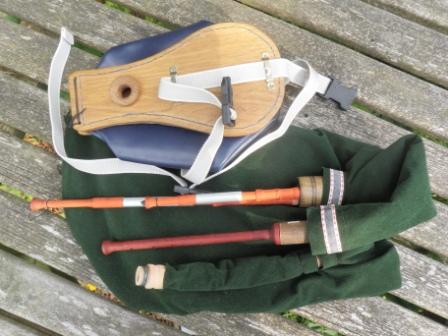
I completed 2 drone stocks for my “workshop pipes” (2 drone holes are drilled at the top of the stock).
If you need to take the drones out of the stock the top part of the stock is removable, the drones stay still and the drone reeds are protected, the bottom stock is fixed snug into the bag via the grove.
The drone stock (lying down) has a smaller hole drilled into its bottom end for air to pass through, this reduces the size of the air hole to stop any drone reeds falling out of the drone seat into the bag; if this happens the top part is removed and the reeds retrieved.
The bellows are finally taking shape to what I imagined. They have studs around the edges for cosmetic purposes, the bellow’s fabric matches the fabric of the bag (different fabric can be sort to the buyers choice).
The shape of the bellows were sourced from a Musette’s bellow I had seen in the National School of Piping’s museum in Glasgow, I thought the design was unusual yet attractive.
The straps have a quick release and adjustable clasp. The bellows have a hinge attachment inside of the cheeks this gives a solid connection. The bellows are completely airtight, they are large enough for NSP and SSP as well as Border Pipes, as they are large less action is needed to inflate the bag.
Although the chanter and drones are still under design, the bag and bellows are beginning to be finalized.

Wednesday, October 14, 2015

Small Pipe Workshop in Hexham

The Small pipe workshop went really well last Saturday in Hexham (Northumbria). The students engaged with the exercises very well and I think got a lot out of it…well I know they did. I got good feedback from them and the boss of Core Music, who ran the event. I would like to do more events there, and do a follow up workshop for the Small pipes, as I feel the students wanted to go further with their playing. They managed to get a regular bellow technique; they got 2 drones in harmony and the beginnings of a steady chanter note, not bad for 3 hours. Northumbrian/closed fingering was popular; I guess Scottish Small pipe fingering is more popular over the border. If lessons could be held regular then I feel they could advance quickly.

Friday, July 24, 2015

New (Old) Tunes to Learn

Coming back from Rothbury Folk Festival i set myself a task of learning new tunes. An interest of mine for many years now has been the old manuscripts of the Scottish Borders: Dixon, Peacock, and Bewick.

I have decided to learn these melodies, memorize them and perform them. They are not being played a lot at festivals, the NSP players are choosing other melodies…which are great, but there is anot a balance.
My task is to first lean the A and B parts to all the tunes, then when I have done that to revisit the manuscripts and learn the C and D parts. I know a lot of the tunes already and I know quite a few of the variations, but I have been concentrating too much on the variations and not on learning the basics of the other tunes.

The tunes I have been working on this week are from the Peacock manuscript, trying to source background information and other links connected with it, it has produced some results, mainly I found another manuscript from the borders that I did not know before.

The titles of the Peacock tunes which I am learning for the first time are:
Over the Border, Jockey Stays Long at the Fair, I Saw My Love Come Passing By Me
  .
Tunes which I knew but had forgotten, which I have been revisiting are:
Neil Gows Wife, Sr. Charles Rant, Bonny Mare and I,  and Tulloch Goram

Wednesday, July 22, 2015

Rothbury Folk Festival 2015

The weekend started on the Thursday before the weekend by going through to Newcastleton, getting up early morning and going to Hexham and playing Northumbrian small pipes for 3 hours in the shopping precinct. Luckily there was not much disturbance and I played ok and got some good responses… always a bit uncertain as Northumbrian pipes in Northumbrian can be a bit like teaching English to the English! Before we left Hexham I visited a music shop (also music co-operative) where I knew they held workshops, I asked about holding my “Small pipe workshop” there, I had a positive response.

Then onto Rothbury Folk Festival, we got there about 5pm set up the tent and headed off for a session in the Queens Head pub. Due to a lot of background noise I opted for the Border pipes tunes.

Saturday was a quick listen to the town pipe band, then the Andy May Trio on the village stage, then off to the piper’s competition in the hall. It was full of people and a good turnout of performers. This year there was Border pipes competition. Listening to the Northumbrian pipers beginners and intermediate performers I noticed a lack of “drone tuning” therefore the pipes sounded horrible “TUNE YOUR DRONES TO THE CHANTER”  it is basic stuff, the judges need to be more strickt about this.

After the duets we headed off to a small room above the Newcastle pub and played a few sets. It was funny really as Border pipers sat in one end of the room and the northumbrian pipers sat in the other end… they did not mix… of course they were friends, but musically there was no common ground. Different tunings (A verses F) loud and soft… except for a few tunes in G (one G border pipe and some had G Northumbrian).

Then off to the Queen’s again for an evening session. This lasted until about 01.30am for me then I wandered off back to the tent. Then a strange thing happened about an hour later I had strong car headlights on my tent, voices calling out “are you in there”. One of my fears in a car/tented campsite is that I get run over by drunken drivers. This seemed to be happening with a car nearly on top of me. I stuck my head out of the tent and there was a police car. They kindly shone a strong beam of light deliberately into my face and asked me “I had seen Andy, who wears a green arm cast?” I replied to the negative. There had been a police helicopter above wakening everyone up and I guess the infrared camera had singled me out as I walked home.

The Sunday was a good small session in the Queen’s lots of varied music and a mixture of styles and instruments and song, I played Northumbrian small pipes more here due to the lack of background noise.
An excellent weekend.

Wednesday, July 8, 2015

Music Software, Notation and Midi Files

I have been working on 2 variations of tunes from the book “The Day It Daws”. By writing out the notation from the book onto “Finale” music notation programme I can hear what it sounds like before I memorize it. The midi file also helps me to memorize the tune by converting it into an mp3 and listening to it via a player.

The 2 variations I am working on at the moment are “The Day Dawes” and “The Day it Dawes” I think both tunes are in the 1500s, but it is a bit confusing in the book to know which tune is being written about, but they are believed to be tunes played by the town pipers.

The other tune is called “Hunts Up” there are 3 variations I am trying out are “”Hunts Up”, “Honsup” and “The Scoth Huntes Suppe” there is another version I will notate also “Scottish Huntsupe”.

These 2 tunes were supposed to be played by the town pipers, the titles are mentioned in literary sources dating from the 16th centuries.

I have notated a few piping books in this way: Dixon’s, Bewick, Peacock, Over the Hills and Far Away. Also parts of the Northumbrian pipers 3rd tune book and the Charlton Memorial Tune book; as well as other music notation from various countries and sources. I put the midi files onto a CD and play them like a music CD, in time the tunes stay in the mind... aids memorization.

It has given me a good insight on how to play these tunes, also for enjoyment. It is an aid to learning passages too as some of the more difficult passages can be broken down and repeated with correct rhythm.

Tuesday, July 7, 2015

Newcastleton Folk Festival 2015 (review)

I had a different, and in many ways a better festival this year. I did not attend the sessions like I normally do. I found last year a bit frustrating with all the noise (drunks not music) and a lack of places to play (for quieter instruments) all added to me walking aimlessly around. This year was different the organizers had added new venues to the places to play, one was a “quiet room” not in the main square (away from the pubs) but where you could have a tune. Also there were fewer drunks there this year and possibly less musicians (?) so I could find places to play.

I found the marquee empty on a Saturday morning so I played my Northumbrian small pipes, I played and played and slowly people began to sit down, after 2 hours of playing the tent was getting full, a few more musicians arrived and added more… then I left, found another piper and played on the grass (Border pipes and Scottish small pipes) and spoke to some people about the festival, piping and things in general. I met with a Northumbrian piper and had a few tunes together.

The after-hours sessions were great, songs and music, which went on until the early hours (got to bed 3am both nights) and on the Sunday night the “survivors session” we finally got out at 5.30am... and excellent sessions (I even sang while playing the pipes… a rare occasion).

The workshop went well, 10am to 12.30pm was useful to the students and myself (I even got a hug off one of them) what was apparent was the lack of contact the individual pipers had (isolation) and no advice or after care help; something they found the workshop was useful for. After the workshop we chatted and played until about 4pm!

I learn a lot too about my pipes and the adjustments I need to make, but the comments about the pipes were good and positive. I will make some mouth blown pipes too incase they will be needed. I will look for more festivals in the future and other venues to attract the students.

Thursday, July 2, 2015

Completed Small Pipes for Newcastleton Folk Festival 2015

There are 7 completed Small pipes for the Newcastleton Folk Festival. I have covered most of the bellows with a fabric except for 2 of them.
Bubinga chanter, cherry and cedar drones. The bellows were donated by a friend this is the only item that I did not make.
Indian Red Wood chanter and drones, the deeper colour on the chanter is due to oiling. The bellows I made in 1994 in Lithuania
Bubinga chanter and drones, cedar wood decoration on drones
Cherry chanter and drones, walnut wood decorations on drones
Bubinga chanter, cherry drones with Indian red wood decorations
Indian red wood chanter and drones, cherry wood decorations on drones, cedar wood decoration on chanter
Cedar chanter and drones, this was the first bagpipe I made in Spain in 2014

Wednesday, July 1, 2015

An Old Sackpipa at Gagnef 2015

I have just returned from a 10 day trip to Sweden to visit my friend and bagpipe maker Bors Anders, we spoke about many things: making pipes, publicizing and developing Swedish bagpipes on line, the development of the reeds etc.
1 week later we drove north to the village called Gagnef for the Sackpipa Meeting. This was my 4th visit and my best due to the fact I had my own sackpipa this time, and was able to join in with the melodies.
The Gagnef group visited the local museum where we saw an old example of a sackpipa with an imitation small drone attatched in the same stock as the larger playable drone. The instrument was in a bad condition, not playable, we noticed the cutting marks of the handmade instrument, the bored out chanter and discussed if it had been turned or drilled on a lathe. 
There was some beautiful design work on the stocks, as well as wooden pegs to place a leather strap over the bindings. Obviously a lot of work was given to the construction of the bag and leather work, but other things like the wooden parts were poorly done. 
The chanter and drone stocks were not centered, the cut of the thumb hole seemed to be for a left handed player (left hand at the top of the chanter), and the finger indentations were all symmetrical cut into the chanter wall.

The ‘owner’ of this pipe was a landlord of a village a few kms away, he owned a pub and also was skilled in leather work, this reflect the workmanship of the leather, but not the wood parts. The bag had been repaired and chanter holes were slits and all had the same size and dimensions…was it ever playable?

Why was there a 2nd drone added? Did he see it somewhere and copied it? Was he copying a set he had seen before or just heard that pipes had 2 drones? Owning an Inn would let him see and hear bagpipes being played from people passing through. Perhaps he had acquired the pipes from a traveler? Perhaps he had seen one and tried to copy it but could not play? Who knows… but it was interesting to see a historical sackpipa which was dated roughly 1850-1900.
The rest of the weekend was playing; sorting out the reeds, socializing, eating and having a great time in the Swedish countryside… loved it.

Wednesday, June 10, 2015

Making Bagpipes: Workshop Leaflet

A leaflet will be given out at the workshop giving contact details and letting people know about other workshop ideas...

"The intension of the workshop is promote the Small pipe tradition to people who have an interest in learning the Northumbrian Small pipes, Scottish Small pipes, Leicestershire Small pipes and other types of bellow-blown pipes. The aim is to provide sets of pipes to develop the student’s playing techniques and offering 3 levels of classes:

The 1st level is the total beginner’s workshop to show the techniques for starting to play.
The 2nd level is a workshop to introduce tunes from the Scottish Borders.
The 3rd level is to teach more demanding tunes and build a varied repertoire.
Within the 3rd level there is the opportunity for the student to buy their small pipes and to continue the classes privately.

(The small pipes in the workshop are made by myself and are of different quality depending on the level of workshop).

To learn more about the musical activities, concerts, lessons and workshops visit my web page http://ethnopiper.blogspot.co.uk or email me at ethnopiper@gmail.com"

Saturday, June 6, 2015

Bagpipe Society Blowout, 2015

It was my first time at the ‘blowout’ (Polesworth, Tamworth, England) in a beautiful surrounding of the Abbey. Each piping culture has its traditions and this was a new tradition for me. Here there was a different style and feeling about the music, pipes, people and events, perhaps a more European style or perhaps an ‘English” style. I say English as it is a reinvention of a tradition that died out. And the reintroduction of the tradition has established a very firm and loyal group of people to their type of music.

I was expecting a heavy influence of French music, but I was surprised to see a good mix of styles in the form of workshops and concerts: Northumbrian/Borders; Occitan from the French Pyrenees; Hungarian; Irish; Welsh... these music’s were played on a type of bagpipe that I have a problem in naming.

They call it a “Border pipe” but I cannot see where their border is exactly? The majority played a type of pipe similar to the French/Belgium bagpipe: mouth blown or bellows blown, conical bored chanter, 2 drones, over-blown into a 2nd octave. Not so loud, plastic reeds, no African Blackwood in sight (made a nice change too) therefore the sound was mellow, perhaps they could call it a “French-Anglo Pipe” as the makers are English and the pipe is modeled on the French/Belgium style.

The makers present (selling their pipes) were in the main hall alongside a Society stall, a flute maker, an Occitan maker. Zampogna maker. There was a 2nd hand section of music books, CDs, cassettes...

One of the workshops I attended was a ‘beginner’s workshop’ to sort out teething problems players were having. This was very informative as it gave me a chance to see how the workshop was structured (with relation to my own workshop); I was also looking for some advice about my Spanish gaita as it was sharp in the bottom notes.  It came apparent that the information was only for a select type of pipes from a select few pipe makers. A general knowledge was not there of conical bored pipes.  The Society was open to all pipes but in reality (at this blowout in particular) only certain types of pipes were represented. Sometimes it felt like if you did not have a bagpipe from a certain type of maker then you were excluded from activities and advice, there was no advice about the Gaita. Also it presumed that because I had “asked the question” that I did not know anything about pipes or conical bored pipes, and I was told to go and "ask (someone) and you will find that the pipes are fine" (meaning “it is you who is wrong” well it seems I know as much as the person who is giving the advice, as he did not know either, a little condescending I thought).

The only sessions available were in D or G, G being the more popular of the 2. G pipes are common in French music, a large bass G. Which is fine, they sounded beautiful. But there are other pipes and I would have liked to have seen a session where any type of pipe could have been played... a few people had brought their sackpipa (key on A minor), , Spanish gaita (C),  , I had with me bagpipes in A minor, C, A major, D, F, and C minor... but no G. I did attend the Irish workshop which was in D, but others I could not. This did not lesson my interest. Other pipes present were a Welsh Pibgorn (D), Leistershire Small pipe (D), Italian Zampogna and there was a Dudy from the Czech/Slovak regions.

The D session on the Saturday was titled “English Session” this apparently is a new occurrence as only English melodies are played (I did not know this at the time and I played a Catalan melody which was met with a silence). After I realized my “mistake” I tried to play along with the English melodies, which there was a lot of. This was the biggest surprise of the weekend, a firm selection of English tunes were being played by all. The Northumbrian tunes came at the end of the night when they had played out all the English tunes. This is great as it establishes a firm melody base of for an English tradition, and leaves the Northumbrian tradition a little apart (which I feel is more accurate as it is more akin to the Scottish/English Border tradition).


Another surprise for me was the Occitan music and bagpipes. 2 makers from the French side of the Pyrenees were offering their instruments for sale, CDs, workshops and concerts. It was a music I only knew a little about (and only recently). They seemed to have a cross-over from the Catalan and Aragon side of the Pyrenees with the Sac de Gemecs (made from a fruit wood, a type of apple) and the Gaita de Boto (complete with snakeskin and girls dress). But also they had their own type of pipes a very large bagpipe in F with a large drone with a knitted “flecco” (decoration). A shepherd’s bagpipe without a drone, deep sound, sad sound, lovely (I had heard this on the Spanish side of the Pyrenees). And the Boha bagpipe with the drone apart of the chanter which can play 2 notes... (Therefore is it really a drone?). Also there was a variant of this having 2 melody pipes and 1 ‘drone’ built into the chanter, single reeds, polyphonic sound.

In the sessions I heard the Welsh Pibgorn, a dingle reeded instrument, 1 octave mouth blown with a distinctive sound, a beautiful decorated horn cut away at the bottom of the chanter, with cylindrical bored chanter.  Their melodies were not dissimilar to a Breton tune, in a minor mode.

The Hungarian duo (pipes and hurdy gurdy) were fantastic players, (I had seen them at the Piping Live Festival in Glasgow a few years previous) tight in their music and ‘tuning’ (an important lesson for us all). Played beautifully with traditional and composed pieces, improvisations and structured parts. The pipes were not so dissimilar to the Occitan Boha. With the Hungarian ’suggesting’ that the Boha was taken from their pipes. They look similar... but who’s came first is a question too far...

My final observation of the weekend was that there is a danger of the “small pipes” becoming obsolete in time due to their quiet nature. Those who had them were drowned out by the conical chanters. This is a reflection of what is happening in sessions too all over the country. If you are “not heard”, why play them? The highland pipe makers are increasing the volume of the “session small pipes” but not so with pipe makers (although there are exceptions). Perhaps the small-pipes need to become more assertive, and insist the venues, meetings, and festivals are predominantly ‘small-pipe sessions’ the same way the ‘English Session’ has become?

Friday, June 5, 2015

Bagpipe Making: Small Drone Parts

I have been making ‘small drone parts’ over the past few days. The original plan was only to have bass drones for the workshop, but the small drone adds to the techniques and is an important part in learning how to play. It can be a little difficult tuning a 2nd drone easily and successfully, an out of tune drone is annoying as an out of tune chanter, so tuning ones ear to a harmony can be useful to know.

I am experimenting with woods, mixing them together, joining them together and playing with outer designs. I do like making the wooden parts.

I made another bellow, still trying different techniques out, experimenting with different glues and ways of assembling in a less messy manner.

If I get the time I will use it with the workshop, but at the moment I am finalizing 7 sets and if I can squeeze in an 8th all well and good.

Tuesday, June 2, 2015

Bagpipe Making: Tuning Chanters

The chanters are being tested to see if they are in the right key. My original idea was to have them all playing in the key of D (a common key for sessions) but after assembling them and testing them out I am finding they are quiet for sessions (due to wood type and reed limitations). So I am forgetting about unifying the chanters in the same key, I will make each of them in tune with the drones so each player can practice by alone (and not as a group).

Thinking more about it this makes more sense as anyone coming with their own small-pipe will be in a different tuning (possibly F, C, Bb, G, A) to my D set,  it only takes 1 key difference to make the group sound discordant. I cannot cater for this. It will be easier to ask the student to play alone, and I can see to them individually, and occasionally to get them together as a group for general discussion.

The workshop will not only be “hands on” practice, but informative with maintenance tips, buying guide, types of pipes etc.  a general introduction. It is catering for the “person who is intending to own a set of Small pipes in the future”. This workshop cannot give them hours of practice (which is what is needed) it can give them ideas on what to look out for and to suggest the steps to practice when they have their own sets.

Friday, May 22, 2015

Sackpipa Practice Chanter

I made a “sackpipa practice chanter” by putting my original chanter into a highland bagpipe practice chanter mouth piece. This gives me an opportunity to learn the melodies before applying them to the bag.

Many years ago when I began researching the sackpipa I made a PowerPoint slide show of the melodies I had collected from the internet (mainly from the early version of Olle’s page), I found the mp3 recordings and added them to the slide show. I had intended to learn these melodies one day using the slide show… now is that day. On screen comes the notation and the music automatically plays; as it plays I follow using fingering patterns only, and then I play the melody myself.

The tunes I have been working on so far with any regularity are:

Jag blaste I min pipa (which I have memorized)
Ljugaren (I have memorized)
Sackpipslat efter Jont Lars Olsson (memorized)
Krigsvisa om danskarna (struggling with this one, to remember the melody, it feels a different style in some way).
Steklat fran Sarna (memorized, but the 2nd half creates some mix ups with the finger order)
Vals fran Enviken (memorized)
Visa fran Venjan (I have been playing this one with the C natural just for easiness; the tune requires a C sharp).
Langdans fran Solleron (memorized)
Bjorskottens polska (memorized)
Polska efter Troskari Erik (struggling, due to the polska rhythm)
Gardsbygubbarnas polska (struggling, 2nd half looses me, the polska rhythm and the duplicate notes)
Miller of Dee (memorized)

Wednesday, May 20, 2015

Bagpipe Making: Help in Making, near Completion

What a difference a few days make when someone comes and helps with the making. Leila flew over from Spain to help with the sewing of the outer bags; she also helped with other aspects of making. By the end of the 3 days we completed all of the assembly, the finer tasks of clack valves, blow pipes, belts for bellows, decoration on the bellows, a new design for the bellows, and securing the wooden drone parts to the metal sliding section.

What is left to do is to drill and fine tune the chanters against the drones, and complete making the reeds. Last week I was wondering if I could complete everything in time but having someone help and encourage and just to bounce ideas helped get through the mountain of jobs that often overwhelmed me. Sometimes, I just froze due to the amount of jobs still to do.

1 bag had to be discarded due to leaking. It was an old bag, an experiment from Spain. It will be easier to make a new bag with the current method than to try and find the leaks.

The next jobs will be tuning of the chanters and making reeds for the drones. It is the last and trickiest task to do.

Wednesday, May 6, 2015

Bagpipe Making: Bellows (1)

I finished gluing the leather to the cheeks of the 1st bellow, and then I left it to dry over night. It was beginning to look like the finished bellow. Instead of screwing the leather to the cheeks, I inserted safety pins into the cheeks to hold the leather while the glue dried. This worked very well and took a lot quicker to do. I can simply pull the pins out and insert the screws later then the glue is dry.

I then started on the 2nd bellow (my own design). I connected the two ends of the leather by stitching and smearing silicone between the folds and over the stitching, and left it to dry over night.

The glued cheek covering (a green velvet) that was done the previous day had glued smooth and came out nice.

I took the stocks out of the bags, ready for dying them to give them some uniformity in design.

Half-Long Pipes: Dixon Melodies

Since 1991 my Half-long pipes have never played correctly mainly due to excess of air needed to keep a pressure in the bag suitable for playing.

Recently I have done some modifications to the drone bore (narrowed it), chanter holes (made them smaller) , and used larger bellows; the result being a in tune chanter of 440c in the key of A, a bag pressure which is slight, and a bellow action that does not have me flapping around like a scared bird.

I have been concentrating on a few melodies to get me back into playing them in a public environment. The melodies are taken from the Dixon manuscript (1733), which is written for the Border pipes.

The titles are:
“Jack Lattin” playing the variations from 1-8;
“The New Way to Bowden” with variations 1-5;
“Mock the Soldier’s Lady” with variations 1-4;
“Dixon’s Highland Laddie” with variations 1-5;

Sackpipa Blog: Sackpipa Melodies

At the end of May I will be going to the Bagpipe Society “Blowout” with my sackpipa, also I am returning to the “Gagnef (Sackpipa) Meeting” this year at the end of June. I have been going to the Gagnef meeting for 4 years (I skipped last year due to financial difficulties), but this year I will be returning with my own sackpipa to join in with the other musicians.

Because of these events I have decided to keep a blog, leading up to the Blowout and Gagnef meetings. I want to document the progress I have/will make regarding the learning of sackpipa melodies and playing techniques (from an UK perspective!).

The recent acquisition of my sackpipa chanter from Bors Anders (instrument maker from Nykoping, Sweden.you can view his web site at www.borsljudet.com ) has enabled me to begin working on Swedish bagpipe melodies. I have had the sackpipa for 2 years but was unable to play it due to a difference in reed/chanter compatibility.


The chanter was made and designed for cane reeds; whereas a synthetic reed from Seth Hammond had been used when I got it. I was finding the top note to be out of tune with the rest of the chanter when set against the drone. Bors Anders very kindly changed the chanter which had been adapted to fit Seth’s reeds (as well as supplying me with Swedish cane for my original chanter).

The result was a tuneful sackpipa chanter. So now I could work on the melodies.

The only notation I had was a book given to me by Bors Anders of his original compositions for sackpipa entitled “Lat Och Olat for Sackpipa” (Swedish characters are not used in the typing), and an A4 size sheet with 5 tunes printed on it. I do not remember where I got this sheet of music from but I did recognize some of the melodies from the titles and I knew them to be traditional... a good place to start learning.

These tunes are: Langdans fran Solleron; Visa fran Venjan; Vals fran Enviken; Ljugaren; Jag Blaste I min pipa.

A few days ago I had visited a piping friend who also is learning the sackpipa, he told me he was learning a few melodies and I thought to give them a try too.

These melodies are: Sackpipa polska; Steklat fran Sarna; Bjorskottens Polska/Polska efter Nedergards Lars.

My first few practices are proving to be fruitful. I have decided to play with completely ‘closed fingering’ (like I play my Northumbrian Small pipes), I did try ‘open’ and ‘semi-open’ fingering, but it felt “natural” to play it this way. 2 years ago at the Gagnef Meeting (2013) in conversation with Olle, he mentioned that there is no “traditional” fingering for the sackpipa, and why not try it fully closed. I can play other pipes, semi and fully open styles, but I like the idea of playing the sackpipa fully closed, especially as I like the staccato style of playing.

I made a recording of the first practice, the tune “Ljugaren” the recording tells of “unsteady bag pressure and‘stiffness’ of style from reading of notation” but early days yet…

Tuesday, May 5, 2015

Bagpipe Making: Bellows

I had some success yesterday, I began by redrawing the plans for the new bellow cheeks, and I also standardized the plans for the leather, ignoring the Northumbrian style as well as the Irish bellow style. I thought why not experiment with my own style.

After drawing the plans, I cut the leather to the new plans.

I started on the Irish bellows, I glued the leather to the cheeks first instead of adding the screws to the cheeks, and then I loosely place the screws to keep the leather in place, and left it to dry for 24 hours.

I drilled the new holes in the new bellow cheeks and put a covering over the wood for decoration.

I then went to the lathe and finished off the bass drone, my best yet, a nice combination of woods (bubinga and cedar).

Sunday, May 3, 2015

Bellow Trouble

Sometimes the work can go smoothly, other times like today it can be really slow and frustrating. The final bass drone is still yet to be completed due to the gluing of the ornamentation.

The fixing of the leather to the bellow cheeks had to be postponed due to the cheeks splitting/cracking. I had to cover the cheek with glue; hopefully this will seal and strengthen the sides making the wood stronger for the screws to go in without splitting the wood. I do not want to revert to the traditional Northumbrian method as I know this works; I want to try new things out. But it is a very slow process having to measure the leather around the cheeks, then sealing and sewing the two ends of the leather together (which I did today), then fixing the leather to the edges of the cheeks.

I do not want to abandon the process just yet, I want to see if I can do it, but it is a method I will not try in the future. Irish pipers have this method for making their bellows, it works fine for them, but for me I need a different system for making bellows.


My own system I will try, straight after I have completed the ‘Irish method’. I have started it already but it is taking time due it is my first try and I am working ‘blind’, after this one it should be smoother.

I dyed and varnished the stocks to make them seem uniform in the bags. This is not essential but from afar it will look presentable; they look like a dark oak colour now.

Friday, May 1, 2015

Cheeks for New Bellows

Today I glued the bass drone pieces together using bubinga and cedar woods, it looks attractive. I will shape it tomorrow then I will have the 7 bass drones made.

I made 7 bellows cheeks today, cut them and sanded them down ready to apply the material. I did away with the curved ends; I want my own design, something to make them a little different. The construction is my own idea, so I might as well make the design a little different too.

The glued fabric on the 2 bellows cheeks I did yesterday was a success, it is ready to apply the “leather” part now…. the tricky bit.