Showing posts with label Sea. Show all posts

Wednesday, October 14, 2015

Sailing on the Solway...only just!

The plan was to spend 4 days sailing on the Solway estuary, to try out sailing techniques and get used to the new sails, but the plans were to change due to the lack of wind.
I left the mooring at Port Carlisle on the flood tide, but there was so little wind the tidal eddy was pulling me near to the harbor wall, I did not want to start the motor (only in emergencies) I wanted to use the wind to get me passed it. The wind blew just enough to pass the mouth of the harbor and I missed the stone structures and the shingle, but only just; then I entered the tidal eddy on the other side of the harbor which pulled me into the main channel and out into the middle of the estuary. There the wind died, also the ebbing tide started to take me towards Bowness-on-Solway.
I wanted to anchor at Bowness, but there was insufficient wind to take me into the bay, I started the motor but it was not enough to pull me free from the ebbing tide, which was fast taking me onwards, passed the viaduct and towards the masts at Anthorn.
The tide was ebbing fast and I knew there was a lot of sand and shallow water to anchor in when the new flood returns. I wanted to get into shore as much as possible out of the path of the Solway Bore (it was coming in high as the tides were 8 meter in height at Silloth and this brought the bore up the estuary).
I tested the depth of the water beneath Sadaf by using a pole, it quickly became shallow and I was a long way from shore, I slowly edged my way towards the shore using the remaining wind. When the keels touched sand I tacked as much as I could into the breeze so to have a shelter for the evening.

As Sadaf dried out I noticed a slight tilting of the hull, this was normal as the keels sink a little into the soft sand. I got out of my wet suit, I did some things in the cabin, when I came out I noticed more titling of the boat. As the water ebbed she titled more and when the sand was visible I saw Sadaf has come to rest in a channel, hard sand was all around, but her keels had rested in a channel that was carrying the ebbing tide out to sea.

I quickly noticed a problem, I could see her keels clearly now. On the starboard side her keel and middle stub was on firm sand, but the rudder and port keel was in the soft sand of the channel, the ebbing sand was taking the soft sand away faster than what was replaced, her keel was not finding compacted sand to rest upon. As the water raced down the channel the sand went with it and Sadaf’s keel sank deeper into the channel’s bed, it was like quicksand she only stopped sinking when the hull had touched the sand and the channel has dried out to a trickle.
Sadaf was healing badly, her gunwale was close to the sand and I was afraid when the flood returned it would gush over the side and into the cockpit, flooding the boat and she would not able to refloat. I tied the anchor warp to her side and hoped it would slow the tilting of the hull. The starboard keel had now slid onto the soft sand too.

As time went on, I had to make a decision whether to stay with her or to leave her for the night. I could not enter the cabin to eat or to rest, I was afraid the added weight would push her further into the soft sand. Night was coming on and I would be sitting about waiting for midnight and the flood to return.

I had visions of her lying on her side while I was there clinging to the mast when the tide returned in pitch darkness. It was a choice I did not make lightly, but I decided to leave her and return to shore and home. I need food anyway (I was going to get it from Annan) and maybe I could get some sleep and return in the morning to either a flooded hull or a righted boat. I set the anchor so if she did refloat she would lift and land on hard sand after the ebb, also I attached my inflatable dinghy to her port side to give added buoyancy when the flood came, attaching rope to the starboard side underneath the hull to the port side so the dinghy would hold its position. I tidied the cabin as much as possible and stored gear. I put away a lot of the sailing equipment and closed the cabin.

Before I left for the night I went to see what I thought were fishing nets in the middle of the channel. As I got closer I noticed they were wooden posts about 10-12ft high, arranged in rows forming something like a “X” design in the sand. I thought perhaps they were left over from the war, used as makers for bombing exercises? Or perhaps they are salmon stakes left over from the seasons fishing? These posts were new; the water had not begun to rot the wood. I remembered a conversation I had with someone from Annan telling me of an “art installation” what was in the main channel and that it was not buoyed or marked in anyway. This must have been it! What great art, to see ones boat impaled and the crew clinging for their lives in mid channel, it being pitch dark or swirling seas, or just a post through the hull and the water gushing in, maybe kids are aboard? What stupidity.
No wonder no one sails in these waters. I have sailed this channel a few times and maybe I have passed over these posts… or just missed them. I returned to the boat, feeling that these waters are not as safe as I once thought, not because of nature, but because of human’s stupidity.

I had with me my fold-away bike, but this had a flat tire (just my luck). I had to quickly blow up the back tire, walk the bike over the sand and then find a way through the moor, bog and gorse to the road.  By this time it was dark, I was tired, hungry (I had had only breakfast) and was worried about the boat, I had a 15 mile cycle ride after I had fixed my puncture. I fixed the puncture but it went down again, in the same spot, I would have to walk home. I started to blow up the tire again, hoping to get on the bike and ride like mad before it deflated, but after a few inflations to my surprise I noticed it was not deflating any longer, perhaps the pressure of the bike had closed the hole and the glue had set? It stayed inflated and I made it home, ate and went straight to bed.

I did not sleep much, logically I knew I had a 50% change of Sadaf refloating, but I felt that I had lost her to the sea, not a nice feeling. I awoke at 6.30am, ate and cycled with my normal bike back to Sadaf, I did not take any food with me as I thought if she was flooded I would need all the space to unpack my things and take what I could home on the bike, so I took only a packed lunch and some tea.
When I got there I was relieved, as there Sadaf was sitting on her keels, on hard sand where I had hoped she would be, attached to her anchors. She would live to fight another day.

I had a couple of hours before the flood so I set all the sails and gear ready to get underway.
In the distance I heard the Solway Bore approaching, and then I saw it coming on the Scottish side of the estuary, white surf doubled over each other, I was pleased I had not grounded in the way of the Bore, as that surf would certainly have entered the cockpit and probably broken the sunken keels off the hull.
As I was quite far from the bore I watched the sea gently come up the channel and reach the boat.

I had set the grapnel anchor just below the hull so not to get it snarled on the keels, and as the sea lifted the stern and floated, I fed out the warp to hold Sadaf fast until there was enough water underneath her. Then I lifted the anchor and set the sails. It is very hard to tell the direction one is going with no wind, the flood tide is not going east, it is moving south (towards the shore) but at the same time it is moving east, and then nearer to shore there is the tidal eddy which is moving west. One thing I noticed about this water is that there is not much still water, as soon as the tide is fully in, it starts to ebb, and then one is fighting a strong current.

I had made perhaps 1 mile, before I started to be pulled back with the ebb, the wind had died, and I was again using the motor to get me east and also trying to get close to the shore to reduce the pull of the tide. I found the 4 hours, until she dried out, very frustrating. In total I had achieved 200 meters, I could still see the wooden posts sticking out of the sands. The good news was I had not landed in a channel (I had checked before she dried out).

Looking at a great sunset I later cycled home to get food. After the sun set came a red moon, a wonderful sight.
The next day I was ready to sail with hope I would get past the viaduct. But the same thing happened again, the flood took me so far and the ebb brought me back to where I had been for the past 2 nights, I could see the ebbing tide pulling me back and my motor could not fight it. In fairness the electric motor is only for getting me to shore if there was no wind (like now) but it was not for fighting one of the strongest tidal flows in the UK. Also the batteries were getting weaker each day; even after charging them via the solar panels they were not fully charged. I was using 2 car batteries a day trying to fight the ebb, each day less power were stored in them so I was getting less hours of usage.

In frustration, I did what I had said I would never do again, and that is get out of the boat and pull Sadaf against the ebb. I dropped the anchor and waited until the ebb was shallow enough up to waist height. I had my wet suit on; I jumped out and pulled Sadaf (it is easier to put the grapnel anchor over the bows and walk backwards, and if you get too deep you can always hang onto the bows) for about 1 mile. The sands were uneven and I suddenly got up to my chest in water, I back tracked and slowly edged into shore, then I was up to my thighs and she dried out.
When the tied was fully out I saw I had crossed a channel and then walked up the other bank. I was quite close to the viaduct and opposite the mouth of Annan Harbor. It is tiring fighting the ebb, but I had made progress and I was closer to the main channel and therefore I had a chance of reaching it before the ebb started the next day. I also thought if I could do this with the last of the next ebb (4am) I would get even closer to the channel and the viaduct. I knew once passed the viaduct I could either get into Bowness, or continue onto Port Carlisle, but the thought of wading through water in the darkness did not excite me very much.
After a beautiful sunset I slept on the boat that night. At 1am the water reached Sadaf, she lifted fast. I went to the anchors to check they were not fouling the keels (I had weighted the warps, but you never know) or lifting out, the pull of the channel was strong on the warps. There was light by the moon and I could see the swell as the channel rebounded off the viaduct walls. Seeing the flood tide at night is a surreal effect, it is moving so fast, speeding, everything is triple speed, not so in the day light, but the night light has a different effect on the tides.
The wind had risen from the east (finally some wind), it would be a lee shore but most of the waves were reduced because of the viaduct. I laid back and tried to sleep, but could not. About 3am Sadaf began to rock violently on the ebbing tide, I thought the lee shore was making itself felt, but as I peered out I saw there were large swells coming from the mouth of the viaduct, perhaps there were accented by the night light, but they were rocking Sadaf in all directions. I was alone in the middle of the night being thrown about the cabin with only an anchor warp stopping me from going out to the Irish Sea…a strange thought. I was sleeping in one of the side bunks, but I moved my bed onto the floor to give the boat more center ballast. After half an hour she had settled down, and I slept until dawn, no night walks that night!

Time passes fast; there is always things to do, eating, tidying, preparing etc. then the tide domes again, relentless. With only a breath of wind I waited until Sadaf floated, I had dug in the Bruce anchor as well as the grapnel would have being pulled out with the force of the flood, and who knows where I would have ended up? When the tide race had passed I pulled up the Bruce anchor and stowed it, then brought up the grapnel, I started the motor immediately I wanted to get into the channel as soon as possible to make the most of the flood tide.

I was edging towards the viaduct, and then my first battery failed. I had my Genoa up and it was just flapping loosely. I quickly changed my battery and switched it on. Nothing! No power, I tried a few times and it sparked into life. I had lost some ground and I was quite close to the viaduct wall, I could see the flood tide swirling around its loose stones. I was too far down and I was being pulled into the wall, not passed it. I tacked Sadaf, so she pointed up channel and hoped she would ferry glide passed the wall. The little motor giving all she could and a slight breeze filling the Genoa, I was edging closer to the wall but also ferry gliding out into the main channel. I had made it. I cut the motor as soon as I passed the wall and put my tiller over so Sadaf spun round and headed down channel, the only movement now was from the flood tide, I had no motor or wind powering me, and I sped along. The swirling tide and eddies all effected direction but I used the rudder to stay pointing down channel. I quickly passed Bowness, and I was soon approaching the harbor wall of Port Carlisle, what a relief to have made it so far, and yet it was not a great distance.

At the harbor I noticed a tidal eddy and what looked like an ebbing tide, had the tide started to ebb already? One moment I was speeding down channel and now it looked like I was to be sped up channel. I did not want to get pulled back so I started the motor and the little electric I had left propelled me (or tired to propel me) passed the harbor wall. But the eddy/ebb was not letting me pass it, with no wind to help I saw staying still…gaining no headway, or was I? I was getting further away from the harbor, it was still the flood tide, but it was going backwards! Suddenly my sails sprang into life, my Main and Genoa was full and I was pulling away from the harbor towards my mooring. The first time in 4 days I was sailing!

Even though I had lost a lot of ground going with the flood tide, the eddy was pulling me back towards the harbor. The closer I got to the shore, the stronger the eddy got. It is an amazing tide, so powerful; it is like sailing in a river that is in flood. But it is my sailing area and I knew its waters well enough. The closer I reached my buoy the more I had to head away from it, up channel. The wind stayed with me, and let the grapnel anchor go and we floated down to rest just beside the buoy.

I set the Bruce anchor and I rested on the hull and fell asleep in the sun. Before Sadaf dried out I tried to retrieve the buoy by motoring to it, but there was no more power in the battery, so I jumped out and secured the buoy to Sadaf manually.
I packed most of the things away, and then I had a 2 mile walk in the dark for my bike that was locked to a tree passed the viaduct. I slept on Sadaf that night and woke the next morning to think fog;
I was lucky enough to get some power out of my solar panels and managed to get some electric into my depleted batteries. I left for home as the tide came again.

Monday, July 29, 2013

Inverters and Electrics on a Small Boat.


I bought a new inverter for the boat, a sign perhaps of my change in function for Sadaf, not the ocean traveler i thought i was, but more of the stay at home kind and snuggled up in a warm bunk with a few home comforts. I bought a 500w 12v inverter to charge up my rechargeable batteries for my radio and mp3 player, and to recharge the computer; I have 3 car batteries and a solar panel which used to be for an electric motor.

The worst thing about the inverter is the noise from the fan, not comfortable. When everything is plugged in the wires are everywhere, and when i recharged the computer battery it must have taken a lot of power as the inverter shut down as the battery got near to the empty mark! I think it would be ok for emergencies but as a thing if relaxation and leisure it did not pass the test. 

I think I will stay with my rechargeable batteries and my speakers, there is no much volume (no amp with them) but it does OK if, like today, it is raining heavy.

Sunday, September 23, 2012

Moving the Earth

As winter is coming I was surprised to see a new mooring close by to my own. When I say "close by" it was too close for Sadaf's comfort. The new warp and the boat would have intruded into the area of Sadaf's swing. As Sadaf's keels are shallow she would have lifted first with the tide and slammed right into the stern of the new boat. I had asked in the village if the new owner could move the mooring away from my own, and as it was in my line of getting away from the mooring, could be positioned quite far away. Nothing happened. So today with some very kind help from Jerry, we dug up the new mooring and positioned it some distance up-tide, still in line with my boat (so not loosing any depth) but far enough away so the boat's stern does not leave a nasty dent in my hull. I will eventually move my boat further up-tide away from the harbour and away from our new visitor, but for now I can be at peace that I will still have a boat to go to. I am playing with the idea of sailing in the winter, Jerry also gave me 3 sails which are a lot lighter and smaller than my present ones. It is much easier to reef and easier to handle, so I might chance a winter's season, as I have done so little sailing this summer...what summer eh?

Monday, April 30, 2012

Gales, Peace and Kite Surfers

The wind was howling from the East, cold wind that made the boat stays sing. I found one of the mooring ropes snapped, it had been at a weak point.There were still 3 more warps attached and a loose chain, but it showed that Sadaf was still getting a battering at the end of April! The tide had been low barely lifting her off the sands. I spent some time fixing the warps making them as one so to add strength to the whole. I went for a walk beside the harbour and sat on the sand out of the wind. Another climate was there, warm sunshine, birds diving and singing, the lapping of the waves that were blown in by the gale, i closed my eyes and rested. Cycling home the ebbing tide was full of white-tops, wind-with-tide...just wait until it was wind-against-tide then it would be a mass of white-horses and crashing waves. I noticed a kite in the distance and nearing I saw kite-surfers bounding over the surf, it was the first time I had seen it close up, good fun!

Thursday, April 19, 2012

Single Axle Trailer

I came across a single axle trailer that belonged to a static caravan, I thought perhaps to convert it into a trailer for my Hurley Felicity. It needed some work of course, but the trailer was in good condition. It had the base of the caravan still fixed a floor of thick ply wood this would need to be removed as the sea would use it as a rudder and perhaps tilt the trailer with the fast tides races we have. There was lights connected but no jocky wheel and I was not sure about any brakes! The trailer was about 20ft the same size as the boat. In the end I decided I did not need it yet, perhaps after the sailing season is over and perhaps a single axle is not the most stable, but I think it would be good enough for pulling the boat to/from the mooring twice a year.

Monday, April 16, 2012

Hoisting the Mast Single-handed

On my 3 previous years I have had help in hoisting the mast, but this year I was alone and I was not even sure if I could do it successfully. It took me a long time to prepare the rig, halyards and stays to be connected and fitted correctly and it is amazing how quickly one forgets!

The lee shore had turned the boat so it sat on a bed of sand and with me trampling over it turned it into a quicksand..going was slow as I had to pull my boot out of the soup underneath me.

After 5 hours of of checking and rechecking the rig in case I had forgotten anything it was time to hoist the mast. I did a trial run and found that stays had lodged themselves under all manner of things, after freeing everything I connected the wooden pole/lever that I had fixed to the pivot axle where the mast rotated. This wooden pole had rope either side of it to stop it tilting too far over. The stay was fitted into a groove at the top of the pole and tied so it would not slip out. The end of the stay was tied to a rope and fed though the a pulley at the bows.

I hoisted the mast onto my shoulder and walked towards the cabin slowly edging the mast high as I walked and taking the weight with the rope. When I could not go any farther I tried to pull on the rope and hoist the mast by using the pole and stay...it did not lift due to the angle of the pole. It was vertical but the mast was not high enough.

I dismantled the rope and fitted another pulley to the stay end, so i could thread the rope through two pulleys so halving the strain on the rope. I repeated the process and when it came to the point where I could not walk any further and support the mast I pulled on the rope and the pulley system enabled me to hoist the mast vertical. It was up, I pulled tight and as it slotted into the base I threaded another bolt into the lower mast section, she was secured.

I jumped down, tightened the stays to the boat and made everything tight.
 

Friday, April 13, 2012

Broken Mooring Chain

As the weather improves I am preparing to put the mast up once more. I was down there today enjoying a coffee in the sun. I realised it is less of a yacht than a cottage by the sea where I can go and relax, do some maintenance and enjoy the nature. I like being there...I prefer being there.

I arrived at the boat the other day to find the mooring chain cut in two. It must have worn through with the high winds and just sheered off leaving the chain slack. Luckily, I had fastened two lengths of nylon rope just in case this happened so Sadaf as the chain was wearing thin, so it was still there and had not floated away with the tide. I have added an extra length of chain over the broken piece until I can buy a new mooring chain of about 25ft.

Wednesday, March 21, 2012

Sail on Sea Kayak

After making my new rig for my Capella Sea kayak, I set everything up in the garden to try it out in a light breeze.
The mast needed supported with bunji straps to take the strain fore and aft; also I noticed a block needed to be fixed in the center of the hull so the paddle will not hit the sheet.
The poly tarp sail is of a Bermudan style, and may need battens to help it have maximum efficiency.
In general, it worked well, probably not good to windward, but on a run, I think it will be enough to rest the arms and use the oar as a rudder. I will be using 'sponsons' either side of the cockpit for stability, and I may even fix a lee-board for upwind use.

Tuesday, February 7, 2012

Porto in Portugal

A recent trip to Aveiro in Portugal to attend an Organology Conference, we stayed in Porto and I was delighted in the overview of the city. Small streets line the banks of the river, an excellent river for kayaking from Spain which I will attempt later this year hopefully.
A view from the bridge onto old Porto
Porto has kept its old feel, small streets large enough to reach across and touch both walls.
Old Medieval Streets


The harbour showed a history in the stone, and boats were there now for touristy purposes, but it added to a charm of the place. The old traditional boats next to the old harbour walls.

Old Harbour
Long oars were used to propel the boats, but they can not have been for sea voyaging on the Atlantic.
Brightly painted sterns. We did not see any sails in use, but in the summer the boats are used for transporting tourists.
Portugal is well known for its coloured tiles on the sides of houses and churches, and railways stations.

Thursday, January 26, 2012

Sail on Sea Kayak

I got round to fixing the existing sail onto the rig of the Capella sea kayak. I found the sail too small and I will make a bigger one, and use it with sponsons to give that extra stability, but I do not intend to use the sail in high winds, the sail is an aid to paddling only, not a substitute. I will be trying out out on the Solway quite soon and getting to channels and rivers that I can not get to by boat. The rigidity is good, the bindings are tight and I believe it is secured tightly.

Tuesday, October 18, 2011

Kayak Frame Completed

I am a firm believer in securing most things on a boat with rope instead of bolts and screws, rope gives a small amount of movement and is easily adjusted and replaced and is less wear on the hull.
 After choosing which frame to use I dispensed with the wood as much as possible to cut down on weight. I placed plastic tubing underneath the frame to give it a level foundation. I then secured the frame to the plastic tubing by way of drilling holes in the frame and tubing and tying it with a plastic line. I tied the tubing to the safety rope which runs along the kayak hull. The tubing is only to give the frame a steady base when heeling. I then secured the frame to the hull by tying it down firmly with bunji. When secured I pulled and tugged at the frame in different directions to assimilate heeling, the kayak moved and the frame stayed secure.
Later, I secured the frame firmly to the hull with a better and more tighter strapping system. Also I inserted the mast and ran a line from the spreaders through the mast head and down to the other spreader this stopped the mast from falling out in a capsize. I pulled at the mast and the kayak moved but the frame stayed rigid. I felt satisfied the frame is ready for the sail.

Thursday, October 13, 2011

Kayak Rig: Work in Progress

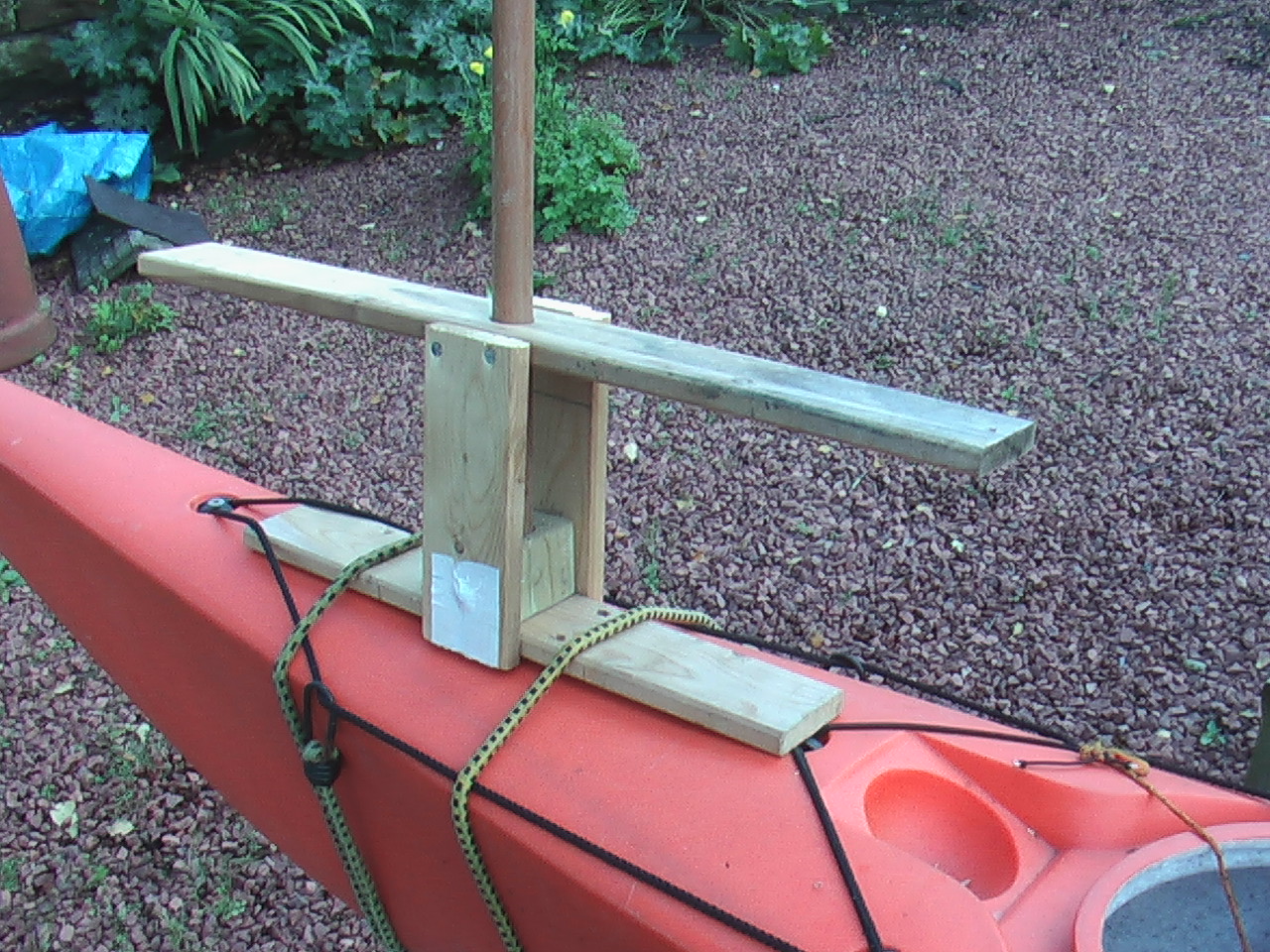
The idea of drilling a hole in the deck to insert the mast is not an option for me. I prefer decks to be as water tight as possible. So the idea is to erect a frame on the hull so the mast can be set into it and left there while kayaking. Since the sail will be hoisted to the mast, it is the sail which will be taken down leaving the mast erect. I started by using the remnants of my previous attempts of a frame. This wooden construction I used for the inflatable kayak but found it too heavy, but it is sturdy enough for the plastic kayak. I screwed the longer panel onto the top of the frame thus creating a 'box' like construction with a hole cut for the mast to go into and a wooden base with a hole drilled to insert the bottom of the mast. The longer top section can be cut to size or left its length to use as 'spreders' if rope stays are to be added to keep the tension of the mast.
Now to choose where to fix the frame and in what position?
I positioned the frame at cross-section to the kayak. Resting above the compass well did give it a balanced secure position.
But with heeling I would have to make the base more secure than only bunji straps.

The next position I tried was to place the frame lengthwise to the kayak hull. This would give stability while Running with the wind, but it was not stable if the wind was beam on.
By placing strips of wood underneath the frame it gave a stronger and sturdier foundation the frame to rest upon the hull. The lengths could by cut to size later flush with the deck. Foam or rubber could be placed underneath these cross-sections to make it plush with the hull to stop the frame from moving.
The next position I tried was similar to the first with the frame at a cross-section to the hull but this time I added a 'V' shaped construction to strengthen the stability when on a Run. This position gave full contact with the hull and added to the strength of the frame.
This is the one I will probably use..but it is early days yet.

Tuesday, October 11, 2011

New Sea Kayak Wheels

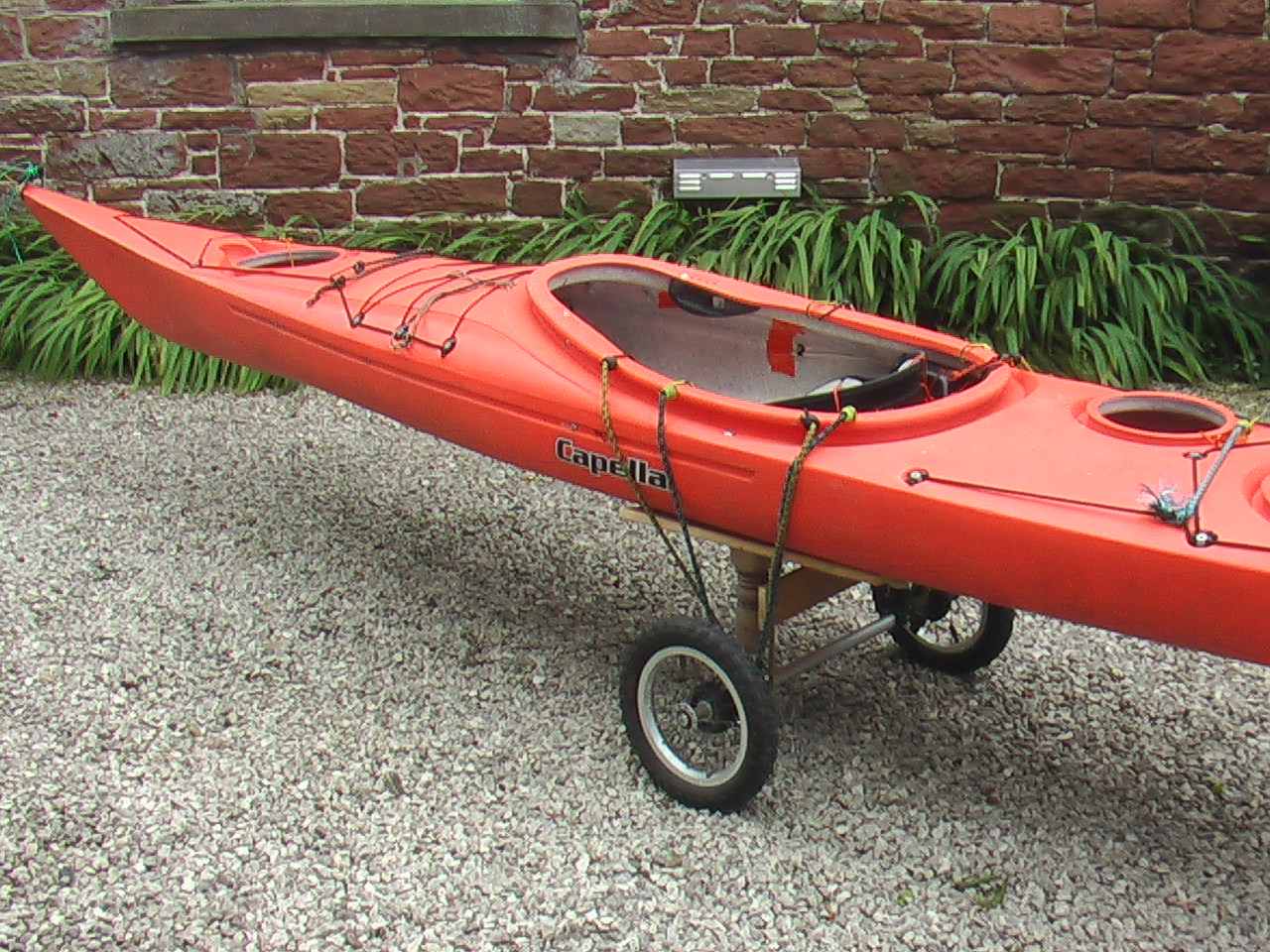
As the previous wheels were too heavy and unstable I decided to make my own frame by turning wood and using the axle of the pram. I cut the joints at an angle so the boards, that the kayak hull will rest upon, sit even. I then fastened another piece of wood to strengthen the 2 legs. I up-turned the kayak positioned the frame and bunji strapped it onto the hull.

After some adjustment I tied it to the bike and positioned the frame in the centre of the kayak, it sat balanced without much weight on the bike frame. I gave it a test run for about 1 mile and it ran very well, it bounced less than before and felt sturdy.Turned easily and did not pull to much going up hill.

I will do a test run to the sea soon and if that is successful I will design another Crab-Claw rig for the kayak.

Wednesday, October 5, 2011

New Wheels for Kayak

It has been over 3 years since I got out the P&H Sea Kayak, the last time was my 4 day journey from Kippford to Gamelsby (Scotland to England). Then I bought my Hurley Felicity and I have been sailing and redesigning her rig (documented in this blog). But now I am turning my thoughts to sea kayaking once more. Partly to do with keeping fit and partly to do with transportation. I wish to see other shores that the Solway Coast and I am not getting out far enough with the Hurley due to our strong winds that we have had for the past few years. Also another factor is I added a sailing rig to my inflatable kayak and this worked fine so I am now thinking to add one to my Capella sea kayak and explore the coast line closer. In a few weeks I will be taking down the mast on the Hurley and mooring her for the winter so the Capella will be in use once more. Since I can transport the 16ft sea kayak by bike I have been making a new frame for her and I got hold of a good set of wheels which turn well due to ball bearings in the axle. This will make it alot easier to transport by bike to the coast. I got the whole frame today and I have been thinking what bits to cut off and what to keep. i think i will take most of it off and keep only the back axle and turn some wood so it can be slotted into the axle base. From this I can add bits to support the hull of the kayak.
The problem with the frame was the height and the weight, it was too high off the ground and able to tip over in high winds, also the whole weight was too much to store.

Friday, September 30, 2011

A few days sailing off the coast of Bowness-on-Solway took us to the sands of Cardurnock Flatts. The wind died away quite quickly and we were left floating admiring the still currents as they still worked and changed which left the sea silent yet busy. We tried to paddle to the shore by using a kayak oar to skull but we ended up going round in circles, so reluctantly we used the electric motor.which took us to the sands where we dried out. We experienced an amazing mirage... it seemed like the tied was drying out very fast revealing an encroaching sand mass moving our way. We thought we were going to be left high and dry by this sand mass that seemed feet in height and drying out the sea. It turned out to be the ripples on the water as a slight breeze came at last, but the immpression was of a sand barrier, very strange.
We dried out on the Flatts for the night admiring the expanse of sand and open sky with an amazing sun set in the evening. Sadaf rested without problems on the sand but a little too into the channel for comfort, a fast tide race would lift us tonight about 12 midnight so we would have to move later into the shore to avoid the anchor dragging. This we did later, but it was still amazing to feel how the power of the channel span us around and moved us fast down tide.
We prepared for the night, 2 people on a boat can always find things to do and there is always things to put away and prepare for the next tide.
On our last day the wind was fresher and Leila took the helm for the first time. She had been crewing for me and she did a good job to get us back to the mooring, but she complained there was not "enough wind"!!!

Wednesday, July 27, 2011

Coast Guard Activities

(8pm) As I waited for the tide to arrive I saw 5 ‘haaf netters’ go out to meet the first of the flood tide, behind them came 2 boys with fishing  rods to perch themselves on top of the harbour wall to do a bit of fishing. The tide barely lifted the boat but the weather had changed from a windless sunny evening to a cold easterly wind, a moonless night followed. I was bounced around while the keels scraped the bottom. The haaf netters returned happy as they had caught a salmon. As darkness came on and the tide ebbed I noticed a car with lights pointing towards the harbour, I thought it was the kids parents coming to pick them up from the harbour wall, then I noticed flashing lights on the Scottish side of the estuary that looked like an ambulance and police car, then a flare went up into the sky. I poked my head out of the cabin I heard radio signals and I put it all together and realised it was the Coast Guard and they were sending a boat out to look for the kids. The car’s headlights turned onto my boat as a land mark for the Coast Guard to head for, and as I could not see anything for the glare I went for a walk to the harbour. I met a coast guard carrying the smaller boy on his back and then followed the older boy. I asked if anyone wanted any hot drinks but the coast guard said “we are loosing water we have to go” (spoken in a Scottish accent, so different from the Cumbrian accent which is only 2 mile across the estuary). The boys had southern accents and were on holiday, they had gone fishing thinking the tide would be out soon but as it comes in fast it went out slow and the cold wind and the darkness made a girlfriend at the caravan park phone for the Coast Guard. The younger boys were not bothered explaining that they had seen several “large fish!” They were dressed in t-shirts; the older boy said “never again, I will now get in trouble off my girlfriend!” They were driven home by the man with the car, it was mid-night.
The authorities have closed the permanent Coast Guard Station at Silloth, now the nearest Station is in Liverpool. These men must have been volunteers on the Scottish side; they did not know the area as the man with the car who evidently must have been the Coast Guard on the Cumbrian side, told them to head for Annan as there is deeper water even with an ebbing tide. With such dangerous waters surely ‘cost’ should not be an issue?

Tuesday, July 26, 2011

Heeled Over...on land

I knew the tide would be low over the next few days, but my thought of sailing was put aside when I saw the position of the boat. It had landed on top of the mooring and was heeled over at quite an alarming angle. Of all the area to choose from the boat had got her keels trapped on a large stone that sat on top of the mooring and this had kept her stationary while the tide ebbed, as she dried out she must of keeled over and stayed that way. I took off her plastic covering and then went to get some bottles of fresh drinking water from Bowness. On returning I attached a rope from her bow to a disused mooring that lay a few meters away I hoped to pull her off the stones if/when she floated at the next tide. I knew the tide was getting lower so there might not be enough water to get her off. As the tide came in I got onto the boat and waited until she floated, load creaks and groans as the boat lifted and shifted her weight. I waited until the tide was full in and then tried to move her. The rope eventually pulled her off the stones as there was no wind and little water. I kept her far from the mooring until the tide went out.

Wednesday, June 22, 2011

More Enjoyable

After writing so much about designing a new rig for the main and the genoa/jib, it is about time I described how they perform. In short very well indeed, I went out over a 4 day period with 2 tides per day and sailed in the morning and evening tides. There were winds from the east and south west and in general moderate winds with occasional Force 4-6, but a steady Force 2-4. I played safe and reefed even when there was little chance of a blow, but for the first time it was wise I did not want the rig to break when I was out there. The rig held well, performed well and I felt I could relax, enjoy it more and not worry about tipping over.
I made some adjustments but basically it was good sailing, she handled well in choppy seas where the channel is narrow and the wind is blowing hard against an ebbing tide, deep troughs were passing underneath her hull and as she was more upright than before she took them better and I did not have to worry too much about those troughs coming into the cockpit. I could turn in these troughs and head back to shore on a broad reach without the rush of speed, which is fine but if one cannot see the bottom it is quite a worry if we are going to scrape the bottom and damage the keels.
Sadaf dried out on the sands.
Lack of speed could be a disadvantage if one is after a racing experience, she moves slower, or perhaps seems that way as before she was heeled over most of the time it was difficult to tell whether she was going fast or slow. But now with her upright hull she moves against tide as well as with it, I can point more into the wind and this makes me sail more in the direction I want too. With less sail up I am surprised how she sails with slight winds. The hardest blow I had she performed well, heeling slightly and responsive when I let out the mainsail. I cleat the jib and as it is self tacking I sail off it. I reef before I sail and have had no need to reef another time.

In total I enjoy it more, I relax more and I worry less. So it is not a bad thing really is it? when I think of it with all the worry, planing and construction i am pleased that it has worked so well. Now maybe I can get some serious sailing done!
All halyards, kicking straps and sheets fed back through the mast