Thursday, December 1, 2011

Casa de Zamora

Links and more links...all are connected so they say. Who would know it but last year a folklorist and music researcher I had met on Facebook called Alberto advised me to go to 'Casa de Zamora' in Madrid if I wanted to learn about bagpipes from the area of Zamora (Gaita Sanabresa) in north western Spain and to meet musicians in the Madrid area. Casa de Zamora is like a cultural centre for people from the Zamora district of Spain. Each region of Spain seems to have these cultural centers in Madrid and elsewhere, often music is practiced in these centers.

 It took me a few more months to finally get round to going and this was due to meeting Alberto in Zamora and listening to his music which finally made me go; I was thrilled by the music and the musical atmosphere in Zamora. The events itself that inspired me I will write about another time, but let me say it was a new experience and it excited me so much to try and learn the Gaita Sanabresa; the Casa de Zamora’s web site (casadezamora.com) listed a gaita class on Wednesdays and last night I went along.
I noted 12 musicians (10 pipers and 2 drummers) and 1 teacher. The gaitas were not all uniform like the gaitas from Asturius or Galicia they were a mixtures of colours, textures, thicknesses and designs. There were a few new surprises such as the wood used to make a couple of chanters, they were made from a heather plant, which for me was a surprise as I know heather in Scotland and it is a small thin plant, but apparently it grows very high here and strong enough to make chanters. I also noticed there were differences in construction. This is partly due to a lack of supply, one maker was mentioned who made good pipes in Cantabria had a waiting list of about 1 year, but he made other types of pipes besides Gaita Sanabresa. 
 If I wanted to learn to play I was advised to get a Galician chanter in Bb (Si bemol) and tape over a section of the 3rd hole making it a minor scale (the popular key of the class was Bb and this was good for singing). The tuning of the chanter was still unclear to me but generally the Sanabresa chanters have a flattened 3rd note and a flattened 6th note, but this was not always the case; and Aliste chanters (the region just south of Sanabresa) had the 3rd note flattened and the 6th note natural. There still needs some clarification in my mind about all of this. The Galician chanters in the class were thinner and slender than the Sanabresa, one boy had quite a thick Sanabresa chanter; their melodies were 1 octave and they used open fingering. The tone was not harsh and with 10 pipers in a small room it was OK on the ears, and time was spent tuning and making sure the pipes were playing in tune together.

 Another point of note was the bag construction, the people who had bought Galician gaitas (so they could learn quickly) had a Galician/Asturian style of bag - 'pear shaped' in style made from Gortex, with the bag cut so the drone stock sits naturally onto the shoulder. The Sanabresa gaita bags had the form of an animal and the drone stock was one of its legs (I do not think an animal skin was used, but the shape of the bag was constructed to look like one) and this 'bent' backwards so the drone went over the shoulder.  Some had tassel's over the drones others with out. 
The drones were thick and differently designed made from different types of wood: 'black wood' and 'red wood', 'knotted wood' and 'heather wood' some of the drone sections had metal rings around the ends as did some of the chanters.
Men and women were learning to play all with different standards, they used notation sometimes but the people seemed to know the melodies from growing up in the Zamora region and were able to play from memory. There were 2 drummers and the rhythms were fast sometimes in 5/8 (aksak rhythm) and other times in more regular patterns, often the rhythm changed half way through a melody from 3/4 to 6/8; often the teacher took the drum when they played as a ensemble.
I was impressed by the whole evening, their friendliness and their music, which I liked a lot.
I will give it a try,...

Wednesday, November 30, 2011

On Stage in Zamora (Spain)

It has been a number of years since I stood on stage alone playing solo. I remembered when I last did it back in the 90s on stage in Vilnius, Lithuania. I have played countless time since then but to stand on stage in front of about 400 people is still a nerve racking event. Playing with others is easier, you follow each other, timing is easier and just to be with another is more relaxing. I have played Border Pipes for years but hardly performed with them on stage and I choose to start the concert with them. My nerves showed for the first set of tunes, but after a while I got used to it and relaxed. When I played the Northumbrian Small Pipes I was back on familiar territory and played my set with out too much trouble.

I do not think it is the 'standing on stage' that is the problem with nerves it is the microphones, it can be in a room with friends or solo recording a CD, but whenever I stand in front of a microphone I grow tense, I do not play as I normal; I can not move or walk around. The microphone rivets me to a spot...curse it.

The melodies I played for the Border pipes (BP) were:
Frisky, Chevy Chase, I'm O'er Young to Marry Yet, Bonny Lad.
Except for Chevy Chase, which is a Border Ballad, the rest of the tunes can be found in the Peacock manuscript from the early 1800s.
The next tune I played was Bonny Pit Laddie, also from Peacock, and I played as many variations as I could remember (I think I missed one out). The style of the Northumbrian and (Scottish) Border repertoire is full of melodies with variations and to memorize them is quite a task; I fail each time but I must say I am also getting better at it too, as my playing time increases so is my memory for these variations.

Next, there was a quick change over of instruments from BP to Northumbrian Small Pipes (NSP). These are quicker to tune than the BP and less problematic to hold and to play. The melodies I played were:
Mallorca, Wards Brae, Gallowgate Lass.
The last two melodies I grouped together into one melody as they are very similar to each other.
The final group of tunes were:
Johnny Armstrong and Welcome to the Town Again,
the first being a Border Ballad melody and the last a dance tune from Peacocks.

The experience was an interesting one, enjoyable and I hope the start of many more to come in the future.

The video is of the first performance on NSP.

Tuesday, October 18, 2011

Kayak Frame Completed

I am a firm believer in securing most things on a boat with rope instead of bolts and screws, rope gives a small amount of movement and is easily adjusted and replaced and is less wear on the hull.
 After choosing which frame to use I dispensed with the wood as much as possible to cut down on weight. I placed plastic tubing underneath the frame to give it a level foundation. I then secured the frame to the plastic tubing by way of drilling holes in the frame and tubing and tying it with a plastic line. I tied the tubing to the safety rope which runs along the kayak hull. The tubing is only to give the frame a steady base when heeling. I then secured the frame to the hull by tying it down firmly with bunji. When secured I pulled and tugged at the frame in different directions to assimilate heeling, the kayak moved and the frame stayed secure.
Later, I secured the frame firmly to the hull with a better and more tighter strapping system. Also I inserted the mast and ran a line from the spreaders through the mast head and down to the other spreader this stopped the mast from falling out in a capsize. I pulled at the mast and the kayak moved but the frame stayed rigid. I felt satisfied the frame is ready for the sail.

Thursday, October 13, 2011

Kayak Rig: Work in Progress

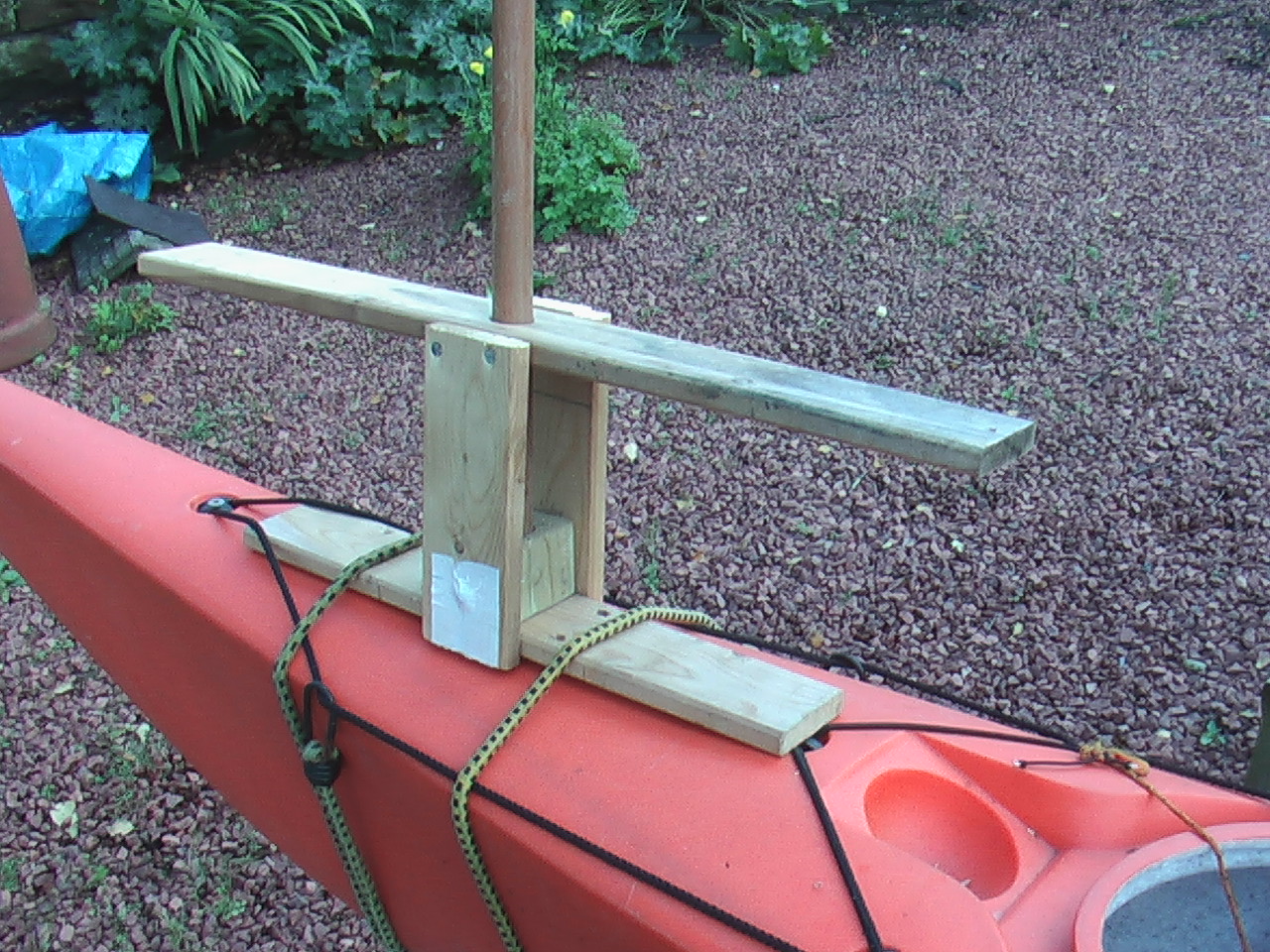
The idea of drilling a hole in the deck to insert the mast is not an option for me. I prefer decks to be as water tight as possible. So the idea is to erect a frame on the hull so the mast can be set into it and left there while kayaking. Since the sail will be hoisted to the mast, it is the sail which will be taken down leaving the mast erect. I started by using the remnants of my previous attempts of a frame. This wooden construction I used for the inflatable kayak but found it too heavy, but it is sturdy enough for the plastic kayak. I screwed the longer panel onto the top of the frame thus creating a 'box' like construction with a hole cut for the mast to go into and a wooden base with a hole drilled to insert the bottom of the mast. The longer top section can be cut to size or left its length to use as 'spreders' if rope stays are to be added to keep the tension of the mast.
Now to choose where to fix the frame and in what position?
I positioned the frame at cross-section to the kayak. Resting above the compass well did give it a balanced secure position.
But with heeling I would have to make the base more secure than only bunji straps.

The next position I tried was to place the frame lengthwise to the kayak hull. This would give stability while Running with the wind, but it was not stable if the wind was beam on.
By placing strips of wood underneath the frame it gave a stronger and sturdier foundation the frame to rest upon the hull. The lengths could by cut to size later flush with the deck. Foam or rubber could be placed underneath these cross-sections to make it plush with the hull to stop the frame from moving.
The next position I tried was similar to the first with the frame at a cross-section to the hull but this time I added a 'V' shaped construction to strengthen the stability when on a Run. This position gave full contact with the hull and added to the strength of the frame.
This is the one I will probably use..but it is early days yet.

Tuesday, October 11, 2011

New Sea Kayak Wheels

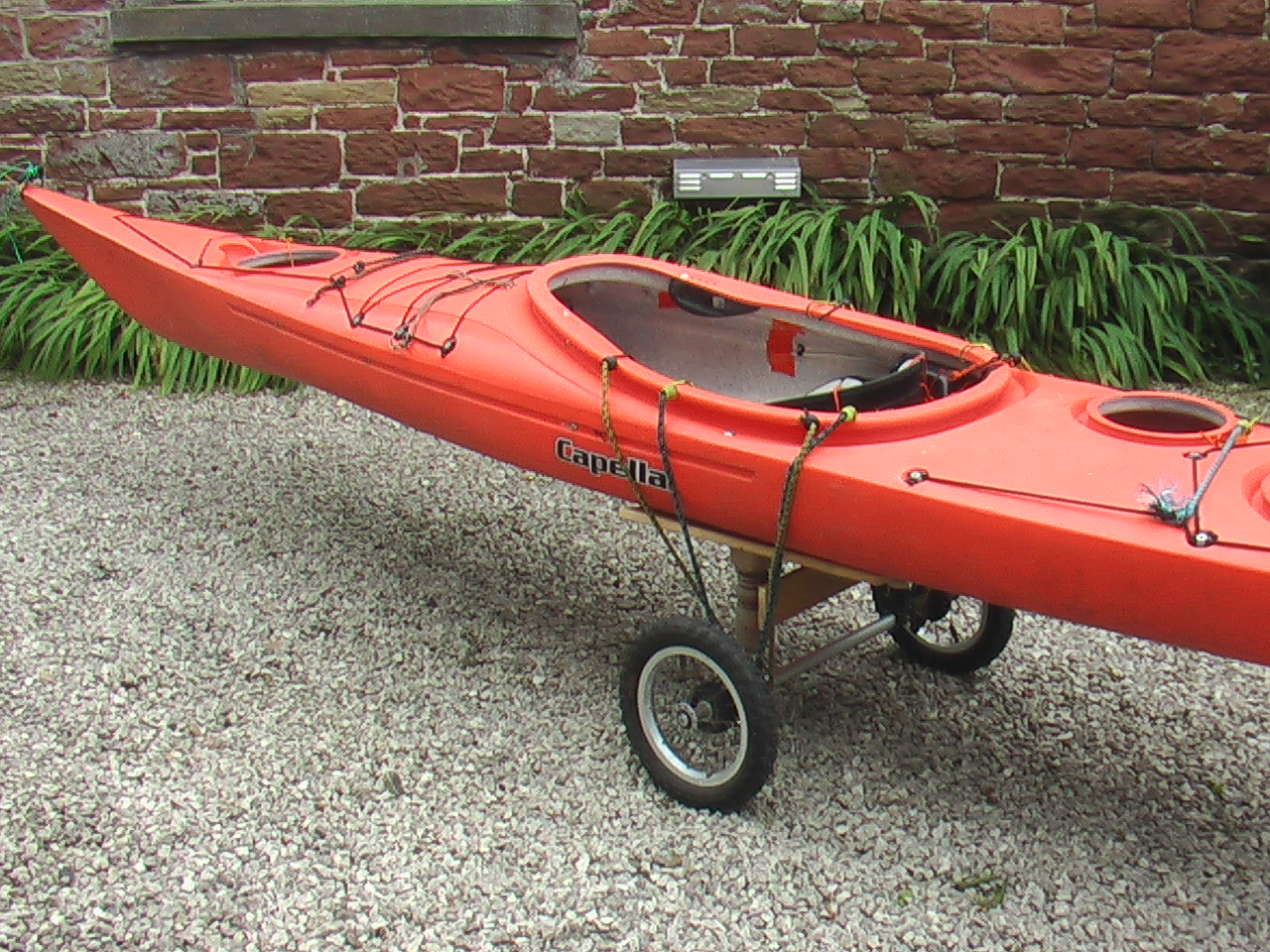
As the previous wheels were too heavy and unstable I decided to make my own frame by turning wood and using the axle of the pram. I cut the joints at an angle so the boards, that the kayak hull will rest upon, sit even. I then fastened another piece of wood to strengthen the 2 legs. I up-turned the kayak positioned the frame and bunji strapped it onto the hull.

After some adjustment I tied it to the bike and positioned the frame in the centre of the kayak, it sat balanced without much weight on the bike frame. I gave it a test run for about 1 mile and it ran very well, it bounced less than before and felt sturdy.Turned easily and did not pull to much going up hill.

I will do a test run to the sea soon and if that is successful I will design another Crab-Claw rig for the kayak.

Wednesday, October 5, 2011

New Wheels for Kayak

It has been over 3 years since I got out the P&H Sea Kayak, the last time was my 4 day journey from Kippford to Gamelsby (Scotland to England). Then I bought my Hurley Felicity and I have been sailing and redesigning her rig (documented in this blog). But now I am turning my thoughts to sea kayaking once more. Partly to do with keeping fit and partly to do with transportation. I wish to see other shores that the Solway Coast and I am not getting out far enough with the Hurley due to our strong winds that we have had for the past few years. Also another factor is I added a sailing rig to my inflatable kayak and this worked fine so I am now thinking to add one to my Capella sea kayak and explore the coast line closer. In a few weeks I will be taking down the mast on the Hurley and mooring her for the winter so the Capella will be in use once more. Since I can transport the 16ft sea kayak by bike I have been making a new frame for her and I got hold of a good set of wheels which turn well due to ball bearings in the axle. This will make it alot easier to transport by bike to the coast. I got the whole frame today and I have been thinking what bits to cut off and what to keep. i think i will take most of it off and keep only the back axle and turn some wood so it can be slotted into the axle base. From this I can add bits to support the hull of the kayak.
The problem with the frame was the height and the weight, it was too high off the ground and able to tip over in high winds, also the whole weight was too much to store.

Friday, September 30, 2011

A few days sailing off the coast of Bowness-on-Solway took us to the sands of Cardurnock Flatts. The wind died away quite quickly and we were left floating admiring the still currents as they still worked and changed which left the sea silent yet busy. We tried to paddle to the shore by using a kayak oar to skull but we ended up going round in circles, so reluctantly we used the electric motor.which took us to the sands where we dried out. We experienced an amazing mirage... it seemed like the tied was drying out very fast revealing an encroaching sand mass moving our way. We thought we were going to be left high and dry by this sand mass that seemed feet in height and drying out the sea. It turned out to be the ripples on the water as a slight breeze came at last, but the immpression was of a sand barrier, very strange.
We dried out on the Flatts for the night admiring the expanse of sand and open sky with an amazing sun set in the evening. Sadaf rested without problems on the sand but a little too into the channel for comfort, a fast tide race would lift us tonight about 12 midnight so we would have to move later into the shore to avoid the anchor dragging. This we did later, but it was still amazing to feel how the power of the channel span us around and moved us fast down tide.
We prepared for the night, 2 people on a boat can always find things to do and there is always things to put away and prepare for the next tide.
On our last day the wind was fresher and Leila took the helm for the first time. She had been crewing for me and she did a good job to get us back to the mooring, but she complained there was not "enough wind"!!!

Monday, September 19, 2011

Txistu Festival in the Basque Country

A recent festival in the Basque Region of Spain of Txistu players. Tey came from all over the Basque Region local groups coming together for an annual festival. The idea was to walk around the streets of Amorebeta and play in their local groups. Later they would meet up and play on mass around the streets until they came to certain bars/pubs where they had a drink, this continued for many hours!! Later there was a meal and more playing and singing, we left at 3am but it was still going on. The next day we heard that the local residence had called the police as txistu was heard at 3.30am!! the video shows singing and playing in the streets, and at one of the many bars the playing of the txistu at night.

Piping Live Festival 2011

In August I attended the annual "Piping Live" Festival in Glasgow. I was more interested in the European performers than the Highland Bagpipes so I recorded the music of Greek, Croation, Spanish and German musicians. There was also music from the Northern Irish Uilleann pipers as well as Border Pipes and of course Scottish pipes. here are a few videos of the events. A song from the Highland tradition played on Scottish Small Pipes.

An Irish Uilleann Piper fresh in from the USA

A Spanish/Galician Gaita demonstrating a rare type of instrument due to its high pitched small drone and untempered tuning.

and 3 young Uilleann pipers from Northern Ireland.

Thursday, August 11, 2011

Gagnef Sackpipa Meeting. 2011

We were woken at 8am by our host playing a rather long trumpet made from wood/bark, so began the day. After breakfast the players of the sackpipa assembled in various places in the garden and played, talked and discussed all things concerning the sackpipa. In the tent at the bottom of the garden there was reed discussions and maintenance. Groups of pipers found each other and played a few tunes, then they dispersed and played elsewhere with different pipers. Here is a video of the Meeting, short video clips shows the weekend events and a small sample of what the event contained. A series of photographs shows the people who attended, pipes played and group activities. If anyone is watching who is interested in attending the Meeting next year it would be well worth the journey, accommodation is available on site. Hope to see you there next year.

Thursday, July 28, 2011

A Path of Colour - Summer Flowers

There has been a few entries in this blog about the journey getting to/from the boat in different seasons of the year. Summer is upon us and sadly disappearing. When I came back from Sweden I noticed how 'green' our roadsides and fields looked compared to the multicoloured equivalents in Sweden, "What has happened to our wild flowers?" I thought. 
Recently I have noticed a change in our country roads, there is more colour, more natural growth of different varieties. I do not know the names of these flowers (there is no need to know to appreciate their colour and beauty) I am just happy there are there; and perhaps they are becoming more widespread than compared to other years, I hope it may continue in years to come. I also notice fields being left and wild flowers growing, if this is EU policy or Farmers taking the initiative, so may it continue

Wednesday, July 27, 2011

Coast Guard Activities

(8pm) As I waited for the tide to arrive I saw 5 ‘haaf netters’ go out to meet the first of the flood tide, behind them came 2 boys with fishing  rods to perch themselves on top of the harbour wall to do a bit of fishing. The tide barely lifted the boat but the weather had changed from a windless sunny evening to a cold easterly wind, a moonless night followed. I was bounced around while the keels scraped the bottom. The haaf netters returned happy as they had caught a salmon. As darkness came on and the tide ebbed I noticed a car with lights pointing towards the harbour, I thought it was the kids parents coming to pick them up from the harbour wall, then I noticed flashing lights on the Scottish side of the estuary that looked like an ambulance and police car, then a flare went up into the sky. I poked my head out of the cabin I heard radio signals and I put it all together and realised it was the Coast Guard and they were sending a boat out to look for the kids. The car’s headlights turned onto my boat as a land mark for the Coast Guard to head for, and as I could not see anything for the glare I went for a walk to the harbour. I met a coast guard carrying the smaller boy on his back and then followed the older boy. I asked if anyone wanted any hot drinks but the coast guard said “we are loosing water we have to go” (spoken in a Scottish accent, so different from the Cumbrian accent which is only 2 mile across the estuary). The boys had southern accents and were on holiday, they had gone fishing thinking the tide would be out soon but as it comes in fast it went out slow and the cold wind and the darkness made a girlfriend at the caravan park phone for the Coast Guard. The younger boys were not bothered explaining that they had seen several “large fish!” They were dressed in t-shirts; the older boy said “never again, I will now get in trouble off my girlfriend!” They were driven home by the man with the car, it was mid-night.
The authorities have closed the permanent Coast Guard Station at Silloth, now the nearest Station is in Liverpool. These men must have been volunteers on the Scottish side; they did not know the area as the man with the car who evidently must have been the Coast Guard on the Cumbrian side, told them to head for Annan as there is deeper water even with an ebbing tide. With such dangerous waters surely ‘cost’ should not be an issue?

Tuesday, July 26, 2011

Heeled Over...on land

I knew the tide would be low over the next few days, but my thought of sailing was put aside when I saw the position of the boat. It had landed on top of the mooring and was heeled over at quite an alarming angle. Of all the area to choose from the boat had got her keels trapped on a large stone that sat on top of the mooring and this had kept her stationary while the tide ebbed, as she dried out she must of keeled over and stayed that way. I took off her plastic covering and then went to get some bottles of fresh drinking water from Bowness. On returning I attached a rope from her bow to a disused mooring that lay a few meters away I hoped to pull her off the stones if/when she floated at the next tide. I knew the tide was getting lower so there might not be enough water to get her off. As the tide came in I got onto the boat and waited until she floated, load creaks and groans as the boat lifted and shifted her weight. I waited until the tide was full in and then tried to move her. The rope eventually pulled her off the stones as there was no wind and little water. I kept her far from the mooring until the tide went out.

Saturday, July 23, 2011

Gagnef Sweden: Sackpipa Meeting

 It was not a festival, it was too intimate for that, but it was a meeting of musicians who play the Swedish bagpipes, the sackpipa. I have been interested in the sackpipa for many years when I bought the LP of solo sackpipa in 1991. I had additional information after that when I visited Sweden and actually got to see the instrument after many years of just listening and seeing photos when I visited a maker near to Nykoping called Bors Anders, he is a maker also of ocarinas. The Sackpipa has 1 drone, 1 melody chanter, 1 bag, it is mouth blown. It has a range of 1 octabe - bottom E to top e, the drones sound in A and the tonic on the chanter can be found half way along the chanter. The Scale is E, F#, G#, A, b, c, d, e (most instruments can also play a c# and a d#) these semitones are opened/closed by placing a rubber band over the hole.
 But my real immersion to this instrument was the meeting in Gagnef in the county of Dalarna, Sweden. There for a weekend we talked about sackpipa and Swedish music, learned about reeds and construction of the instrument, its evolving status amongst other single beating bagpipes. It is classified as a "simple" instrument due to its single beating reed construction, but it is far from simple! It is quite complicated and getting more advanced as the makers think of new and inventive ways to improve the instrument, its sound and by doing so are creating a new tradition. I was greatly inspired by the event and I have learned a lot about my own playing and instrument by listening to the musicians there. The people were very welcoming; they took the time to speak English and converse with me about their instrument and also about my own Northumbrian Pipes. The players rarely meet to play together and there was a mixture of advanced players and some who were just starting out and all said they had learned from each other. What was special about the meeting was the atmosphere, the closeness of the meeting, the friendliness I felt as an outsider. Certain players played well together, blending harmonies and sweet sounding chanters that I hope, in time, will be recorded and reproduced on a CD. I came away with a lot of ideas about recording and documenting what I had seen. It is changing fast and a lot of techniques and information would have changed by next year, so it is important to document it and preserve it for the future. I hope to make a detailed video of the meeting next year and record the music and performances, dialogue and reed and pipe maintenance as a decade from now I am sure it will have advanced a lot and knowledge will have been lost just as the knowledge has been lost for the 1970s
 

Friday, July 15, 2011

D Drones and the Sackpipa

After coming home from Sweden, where I had attended the Sackpipa Festival (Swedish Bagpipes), I started busking. I have not busked for a few months, I have been too busy with the new rig on the boat. But on my birthday I felt like going out and busking just for enjoyment. When I was playing I had trouble with my G bass drone, it would not staying in tune but kept on going flat. Today it did the same thing and I knocked it off and set the bass D drone instead, so having 2 D drones playing D/d.. I got this idea of a few Cumbrian pipers who just so happen play with their D drones all the time whether in the key of G or D. The Swedish sackpipa players have a chanter which is A, but their drones are in E, which is a similar arangement. I played a lot of melodies today using the D drones and after first thinking it does not sound right...as I am so used to the G/d drone arangement, I started to think how compatable they are together. The D drone compliments the bass notes on the chanter, the F# and the A as well as being in tune with the G (root note) it is quiet and in the top octave the harmonies sound less complicated than with the G/d drones, and the D drone stays in tune!
Another influence from the Sackpipa Festival was the re-tuning of the Border pipes by using tape. I have always had problems with my Border pipes or should I say with the reeds. I could never get the whole chanter in tune with itself whilst being in A (440c) it was ok when it was flat, but in A I had problems. The Sackpipa players cover their holes with rubber bands to tune the chanter, so I covered the holes with tape to make a few notes flatter/sharper and now it is in tune, in concert pitch A and sounding quite nice, again with 2 drones (tenor and bass) tuned in A.

Wednesday, June 22, 2011

More Enjoyable

After writing so much about designing a new rig for the main and the genoa/jib, it is about time I described how they perform. In short very well indeed, I went out over a 4 day period with 2 tides per day and sailed in the morning and evening tides. There were winds from the east and south west and in general moderate winds with occasional Force 4-6, but a steady Force 2-4. I played safe and reefed even when there was little chance of a blow, but for the first time it was wise I did not want the rig to break when I was out there. The rig held well, performed well and I felt I could relax, enjoy it more and not worry about tipping over.
I made some adjustments but basically it was good sailing, she handled well in choppy seas where the channel is narrow and the wind is blowing hard against an ebbing tide, deep troughs were passing underneath her hull and as she was more upright than before she took them better and I did not have to worry too much about those troughs coming into the cockpit. I could turn in these troughs and head back to shore on a broad reach without the rush of speed, which is fine but if one cannot see the bottom it is quite a worry if we are going to scrape the bottom and damage the keels.
Sadaf dried out on the sands.
Lack of speed could be a disadvantage if one is after a racing experience, she moves slower, or perhaps seems that way as before she was heeled over most of the time it was difficult to tell whether she was going fast or slow. But now with her upright hull she moves against tide as well as with it, I can point more into the wind and this makes me sail more in the direction I want too. With less sail up I am surprised how she sails with slight winds. The hardest blow I had she performed well, heeling slightly and responsive when I let out the mainsail. I cleat the jib and as it is self tacking I sail off it. I reef before I sail and have had no need to reef another time.

In total I enjoy it more, I relax more and I worry less. So it is not a bad thing really is it? when I think of it with all the worry, planing and construction i am pleased that it has worked so well. Now maybe I can get some serious sailing done!
All halyards, kicking straps and sheets fed back through the mast

Tuesday, May 31, 2011

Testing my Kayaksailing Rig in a Force 4

The 2nd day was more lively. The wind had re-turned blowing about a Force 4, it was strong enough to test the rig and to make the incoming tide choppy. I desided to go in an anti-clockwise direction around the harbour walls so I would get an all point sailing direction, for the rig and wind; with a reach and a run, tacking and gybing. Some areas were calmer than others, by the mouth of the harbour it was quite a race. The rig gybed without any problems, it did not heel me too much and even in the thick of it I was not knocked off balance. On one tack it worked well but on the other it was less efficient, but this is true with all sailing rigs. I was still using the sail as an aid to paddling not a sailing rig in its own right. It gave me a feeling of an 'added paddler', and certainly made my paddling a lot easier and increased my speed, but I could now by how much. Very please with the results in such conditions. I could change the sheets with my new cleats and sheets, positioning them so I could get at them easily and even with the wind pushing me off course I could sheet in the sail or let it out with out fumbling for the cleat. Works best on a run.

New Trials with the Improved Kayaksail Rig

I was waiting for a good day to test my new Crab-claw kayak sailing rig. I had made some new changes since my 1st attempt. I got rid of the wooden frame as it was too heavy to carry, and I made a simpler construction out of plastic tubing. It was a lot easier to assembly and the purchase of new cleats and sheets made the whole process a lot easier and enjoyable.
The gales had gone leaving very little wind which eventually died away to nothing. I got up early morning to meet the tide and enjoyed a good time following the tide down to Drumbrugh where I noticed the banks errosion from the tide on the English side (they joke "Scotland is getting bigger as England gets smaller).
The wind died and the rain came, I paddled past Port Carlisle down to Bowness-on-Solway with the ebb and pushed against the ebb to get back to Port Carlisle. Not an exciting morning but it was very enjoyable and gave me the confidence to know that the rig was ok and in working order. The rig was easier to set up and although there was not much wind she performned well and did as she should. I still was using a Leeboard put my paddle for directional control, it works fine for this rig/kayak. When the wind gets too strong I paddle into the wind and cleat in hard. The sail does not flap around and she does not heel me, so in a way it is like reefing.

Tuesday, May 24, 2011

Wind Gusts

The evening of the 22nd looked promising, Sunday evening and the sun was out and the wind had died down to a breeze on the way to the boat. I brought out the mainsail hoping to mark reef points onto the sail but this was difficult with the midges attacking from the gorse bushes nearby. As the sun set I hoisted the sail to test it out, not a great success, so I dispensed with the lower baton and furled it around the boom, it set fine. I packed everything away as the wind came back and remained with me all night; I made food and prepared to sleep. I did not sleep much as the wind howled and rocked the boat. At 4am the tide came in and Sadaf began to scrape on the stony bottom, then she heeled drastically as her keels got stuck on the stones and the wind pushed her over, she skidded and slid away and came up again. When there was depth she danced around the mooring as the wind pushed her about. She would get a gust on her beam and she would heel over and come into the wind then would right herself. Often the gusts would blow her to her mooring chain’s length then she would jerk forward. I did not sleep at all, the rain pelted the cabin, we were tossed around, and the sounds of the jerking and heeling made it impossible to feel calm.


When the tide was out I ate, read then slept until about 1pm. I went for a walk and saw a mass of pink flowers along the saltings; I walked over the sands out to the low tide mark. The wind was shrieking across the shallow pools leaving dark streaks on the water, shaking my hands as I took the videos. The wind increased when I got to the tide, it was lifting the waves and throwing them over the surface as spray. In the distance the dry sand of Rockcliff Marshes was treated in the same way making it look like the Sahara in a dust storm. I turn and faced the wind and it nearly blew me over. The center of the channel was a mass of white tops and I noticed that the tide was advancing against the wind, tide was coming in and I was a long way from Sadaf. There was a channel between me and the boat. I walked fast but was hampered by the wind, I ran and could hardly make headway so strong was the gusts. I waded through the channel and headed for the boat, reaching it as the tide encroached.
On the boat there was a repeat as the morning, but with more wind strength and gusts that heel Sadaf drastically and pulled at her mooring chain with loud bangs. I changed into my wet suit and put on my life jacket, I also got ready 2 anchors incase she pulled from the mooring. After a while I got used to these conditions and read and cooked, amazing how you can get used to new situations. I videoed the sea but the wind’s strength actually flattened the waves and made it look quite flat on the video.

A brief shower brought with it a glorious rainbow over the estuary. The Shipping forecast for that day reads: Irish Sea, Gale warning issued 23 May 15:30 UTC. Storm force 10 veering westerly and decreasing gale force 8 imminent
• Wind Westerly or southwesterly 6 to gale 8, occasionally severe gale 9 at first, decreasing 5 or 6.
• Sea State Moderate or rough.
• Weather Showers.
• Visibility Good.

Tuesday, May 17, 2011

Galician Gaita on the Basque Streets

While walking through the countryside of the Basques (northern Spain) we came across a woman busking on the streets of Bermeo, playing Galician gaita (bagpipes). She was hot as standing in the sun and the sound echoed all around the area.

I talked with her a short while and she was grom the west side of Spain (Galicia) and touring around for the Easter holidays.

Saturday, May 14, 2011

Reefing the Jib Spar

It was not the best of days to test out my jib reefing system but in another way it was ideal. Heavy rain and gale force winds blew me and the jib all over the place, but these conditions I would have to reef while out at sea so I tried to do it while I was learning how to do it. In the end after trying different ways I settled on the hanks remaining in place (around the forestay) while I attached the last one to a shackle on the spar. I then furled the jib around the spar but I found it just as effective to slap reef it and tie the loose jib to the spar with reef knots. As the jib became smaller the end of the spar was sticking out with the jib not supporting it so it was dipping down onto the hull. I fixed a rope from the top of the jib down to where I wanted the spar to be and tied it off, this enabled the spar to be at the correct angle away from the hull and side stays as it swung (as the jib got smaller this rope had to be shortened to keep the spar at the right distance).
I had marked where the reef would be so it matched where the hanks were situated, when I had shackled the hank I could position the marking on the spar and bunji strap it, this gave me the correct distance between the two reef points. The rest of the loose jib I reefed with ties. As the jib was now shorter I had to make the rope shorter too to compensate and keep it off the deck and swinging freely. If I pre-mark the points where the rope needs to be shortened and using a quick release shackle I can complete the reef faster. In total there will be 3-4 reef points the last being so small as to make it a storm jib.

Monday, May 9, 2011

Spar on the Jib


I finally sorted out my oversized genoa problem and reefing problem. I fitted a spar to the foot of the genoa and by rolling up the excess sail from the foot and tying it off with bunji straps effectively making it a jib. I fix the jib sheet to the spar (and not to the sail); I fix the other end of the spar to the jib forestay and attach it also to the hull by shackles/rope. The spar is cut to length so it will miss the side stays and swing easily. I use one jib sheet that goes inside of the side stays and I bring the sheet back to the cockpit.
I can roll up the jib for reefing in the same way by attaching the jib slug to the spar and tying off the other end, but I cannot do this from the cockpit...yet, but it does reduce the sail to a manageable size and it seems well balanced compared to the other ways I have tried.
By having a spar on the jib it will be more stable and less likely to flog in the wind, I think performance will be improved by having it. I can drop it quickly when needed and raise it just as easily.

Thursday, May 5, 2011

A Problem with the Rig...again!

It was the first time this year I had a chance to go sailing, but although the weather conditions were nice my bilge keeler was not! She had not been tested since I put the mast up in April. The mast was too far forward so when I hoisted the genoa the luff was slack. I began to reposition the stays, slackening the forestays and tightening the backstay until the mast head was pointing backwards slightly. Hoisting the genoa this time meant that the luff was tight. I then tried to reduce genoa size my wrapping it around the forestay but the wind took it and it started to unwind. I noticed that the tack was not cut right, and the corner tension was not right, this is why it was flapping. Whoever had sewn this genoa had done a bad job. I was getting quite mad, 2 years of trying to get this boat to sail is wearing me out.
I decided I could dispense with the furling idea, and dispense with the badly sewn tack. I would reduce sail permanently by rolling up the foot of the genoa around a boom. The boom would be long enough to go past the side stays without touching them, in effect making it a self tacking jib.

I next tried the mainsail and after a few tries I reefed the main to a modest size. I am concerned about all this as I realise one of the faults with the Hurley Felicity is that the keels are too small, so when out at sea with full sail she heels over rather badly. All last summer I was sailing in strong winds and she was heeled over most of the time. So I have decided to reduce the sail area so she will be more controllable and pleasanter to handle. There was no reefing system on either of the sails so I have had to make my own, but finding a badly cut genoa is too much for me to correct. So I hope by getting it out of the way completely will make a small jib easier to control.

Monday, May 2, 2011

Redesigning Kayak Rig

After a delightful time in Spain, I came home with pits and pieces to add to my inflatable kayak rig...4mm chord, cleats etc. to make it more efficient and safer while on the water. By adding these bits I slowly began to modify it more, in the end I completely re-did the structure. I built a frame for the mast to fit into; I re-drilled the bottom and top cross beams and added a thicker wooden mast higher than previous; I widened the cross beams to I can add a 3ft leeboard and strengthened it with an extra piece of wood for the tube to sit upon as it holds the leeboard. The mast and the yard are telescopic so I can reduce their size when travelling. The cleats I fixed to a plank of wood that extends underneath the seat, my body pressure keeps the plank/cleats firmly fixed, and yet I can remove them when not in use/travelling. I fixed pulleys and the sail hoisted very easily and I could cleat it off effortlessly and quickly. The wind was very strong gale force winds blew the sail about as I experimented, without paying attention the boom jibed and caught me on the side of the temple, luckily I was in my garden and not out at sea, it was a wake-up call and I will remember to watch the boom in future. I will replace the boom with a lighter material.
The picture is the newly constructed frame and mast, with leeboard down the side of the kayak.

Wednesday, April 27, 2011

The Txistu and Danbolina : Basque Flute and Tabor

We had spent 5 days walking through the Basque Region of Spain and we ended our travels at a small town near to Bilbao called Amorebeita. Here we met a musician who played the Txistu (flute) and Danbolina (tabor).
These instruments have an unbroken tradition in the Basque country (as well as other parts of Spain too) but what makes the Basque Txistu a little different is that they have been changed to bring them more into a "classical" repertoire. My knowledge of this instrument (as in indeed all Spanish instruments) is limited, but I am finding that the tuning, scale, range of the txistu has been tempered and fixed so that it can be played more easily with other instruments.
The txistu is a 3 holed fipple flute played with one hand, and it can have a range of over 2 octaves and is fully chromatic. It is made from various black coloured hard woods or hard plastics, the fipple mouth piece is made from metal and it is generally found in the key of F (or F sharp if it is played on the streets, as it produces a louder sound). We spent a great weekend with Iban, who let us attend his performances:
On the saturday there was a txistu/danbolina and dance performance for the pensioners at an old peoples center. One man danced a traditional dance dancing the 1st and the 4th part of 4 part dance, while Iban played the txistu and danbolina together (one hand the melody and the other hand the rhythm).

Next there was a march/procession around various streets of Santurtzi, here 3 txistularia played and marched, stopping at various bars along the way!!
That was the end of the formal playing, but as there was a Basque football match on that night the txistu and danbolina was brought along to play various football and traditional Basque melodies.
The Sunday was a march/procession around the streets of Amorebeita, an unbroken tradition (except for 3-4 years in the 90s) where the txistularia play various melodies and stop off at various bars playing a mix of Basque and Spanish melodies for the people who often come out onto the streets and make an occasion of it with wine and food.

Extremadura Folklore Ensemble

While on holiday in the Basque Region of Spain I came across a folk group on the streets of Santurtzi (Bilbao). I was there meeting Basque musicians who play the Txistu so I did not have time to stop and take the performance at its full length. Here is a small clip of the group. Extremadura is a region of Spain close to Portugal, it is the Central/Eastern side of Spain. I know very little about the area but I know they have a similar pipe and tabor to the Leon/Salamanca regions and to Basques. Here they have beautiful colourful costumes and are dancing to the music of that region.

Monday, April 25, 2011

First Sail with the Crab-Claw Rig Kayak

This is the video of my first trip with the Gumotex inflatable kayak on the Solway Estuary using the design of the Polynesian catamaran rig. There is less stress on the boat in a jibe and easily erected and carried.

Thursday, April 14, 2011

Hoisting the Masts: On Kayak and Sail Boat

I put the mast up on the Hurley Felicity about 2 weeks ago during a flat calm, no wind was stirring. My sister came at 6am and we went down to the mooring and got her ready for the lifting. I had a new idea of using a series of pulleys for hoisting the mast. These pulleys were connected to the fore-stay and the sheet was led back to the cockpit. The idea was to raise the mast by hand as far as I could lift it then use the pulleys to hoist her fully up. My sister was there just to see that if it lent one way she would correct it, it was a trial and error situation. It did not work!! The pulleys kept on getting jammed, i adjusted them so the sheet stayed on the wheels, but they kept on jamming. In the end i asked my sister to pull on the fire-stay and the mast went up easy enough!
Then we had gales so the the next week I could not do any sailing, the winds did not abate and I decided to try out my design of the Lateen rig on my Gumotex kayak. I had been designing and building a rig over the winter. The sail was made from tarpaulin and i had a short un-stayed mast. When hoisted the sail sat at 45degrees to the hull with little head room clearance. The foot of the sail had a spar.
My first tempt was a success, she sailed Ok, the winds were slight and there was a few days of quiets winds, excellent conditions for the first sail. It took me ages to set up, but when hoisted I found she was good sailing down wind on a run, and tacking into the wind she was Ok. One difficulty I had was when sailing on a tack I would use the paddles as a rudder so I needed 2 hands to control the paddle and also to control the main-sheet. This was a problem as either the main-sheet could not be adjusted efficiently or the paddle was not stable.
The latest sail was done over a 2 day period, I slept on the Felicity and tried out the kayak during the day. I changed the sail so the yard was close to the small mast pointing upward, brought into the top of the mast by a pulley. I fixed the bottom of the yard to the middle of the mast. I also strengthened the mast by fixing a bunji cord as a fore-stay. This helped me to hoist the sail in close to the mast without it moving too much and for the mast to get in the way of the paddle and my face! With the yard vertical the spar and sail had enough clearance for me to use the paddle in a more effective way. Also I cleated the main-sheet so I could paddle/steer off the wind so I could have the sail working in conjunction with the paddle, sometimes I would stop paddling other times I would steer and other times I would paddle...or drop the sail if it became in-effective.

Thursday, February 24, 2011

An Unpredictable Day

The day started off routinely, I cycled to the boat intending to clean the inside ready for painting. I checked it for water in the bilges. There was quite a bit of water but it was fresh water it was not from the sea, I have no idea where it is coming in from. I played flute for a short while, made a coffee... Then my friend and his 2 children came over and the kids climbed on board and came in the cabin. They were asking a lot of questions about the boat and they had never been on board a cabin boat before. They asked questions about sailing and other nautical things "how do you know what 3 knots is?" errrrrrrrr! I did not do any painting as the tide rushed in and as I was closing up the cockpit and preparing to leave my friend started talking to me about his new love in his life. We headed back to the shore and went for a walk around the village. As I was leaving I realised I had left my bike bag on the boat with all my tools, phone etc lying in the cockpit. I thought to leave it until another day but it could get stolen or I could have a puncture and walk home. So I decided to wait until the tide went out. I calculated it would be out about 7pm, it was 3pm when I realised so a long wait was in store. I laid down and watched the sky pass above me, but it was cold the wind was blowing the clouds by, so I got on my bike and headed out past Bowness along a small road along the salt marshes. I had not biked along that road for decades and it was lovely, quiet and windblown. I headed back to the boat but the tide was still coming in. I cycled in the opposite direction and walked for a bit by the shore, getting chilled as the wind got stronger. I cycled back and then I cycled again towards Bowness. It was getting dark when I reached the boat again and there was my friend waiting in his car. He had come back with a flask of coffee and prepared to wait it out with me. We had a nice chat and as 7pm approached he drove off leaving me to wade out to the boat in freezing water in the darkness. I took off my shoes and the icy water went above the knees and they went numb. I got my bag and returned and realised I had forgotten my phone so back I went this time inside the cabin searching in the darkness for my phone. Luckily I noticed some beach shoes in the cabin and wore them so no stub my frozen toes on the rocks. As I jumped down from the boat my sole of the beach shoe went through a spike that was in a fishing weight on the sea floor. If I did not have the shoes on I would have had a 4cm spike through my foot, as it hit the sole it bent and missed my heel by millimetres. Then I cycled home without lights on my bike, when a car came towards me I used my mobile phone light as a lamp light. I got home about 8.30pm.

Thursday, February 17, 2011

Pipes, Concertina and Boat.

I have been back from Madrid now for 4 days and I have busy with one thing and another.

Monday i went to the boat to check on her, she was fine, the strong winds had blown off a section of tarp and i tied it down with more ropes as the strong winds are not finished yet and bailed a little water out from the bilges. I brought the seat covers home to be cleaned.

I tired busking in Carlisle from 4pm until 6pm tuesday and wednesday, but it was slow. It is a time i normally do not play, but since i was going to be in town in the evenings i thought i would give it a try, anyways it is good for practising if nothing else.

Thursday, I played some European melodies on the concertina: Galician, French and Swedish in preparation for a practise next week with the harpist. Later, I got the Border pipes out and practised for tomorrow's session in Langholm with 2 other Border pipers. The melodies are long, and I am out of practise with the runs and keeping the instrument steady, but they sounded good and relatively in tune to concert pitch "A"...amazing. I mended the strap on my bellows to make it more secure, as it has a habit of coming off in mid-tune. Played more in the evening until my ears rang!

Tuesday, February 8, 2011

Spanish Gaita and Uilleann Pipes

The Irish music session at Taberna Elisa last night was even better than last week with tunes coming fast and furious and with a lot more energy. An addition of an fiddler and a guitarist who also played button accordion made a fuller sound. Pennie whistles were brought out to play along with the flutes. What attracted my attention was a man who played one of these whistles also took out a Galician gaita/bagpipe and played along with the Irish melodies. I had seen this man before at the Spanish Jam session on a Friday night, and I had meant to ask him about his pipes. They were in the key of D/Re which is perhaps is unusual as most of the gaita players play in the key of C/Do. The chanter was smaller than the C chanters in fact the over all bagpipe was smaller to what I had seen before and higher in pitch. With this smaller chanter he could over blow into the 2nd octave and achieve a larger range of notes that the C chanter could not get (an extra 4), reaching a top C/Do so it would fit quite well with Irish melodies, also it had the European open fingering technique so it was fully chromatic within 2 octaves, quite a versatile instrument. His drone arrangement was standard: one D/Re bass drone over his shoulder and a smaller tenor drone across his chest also in D/Re. What was unusual was he would remove the top end of the drone and this would give him a drone sound in E/Mi so he could play melodies with a drone accompaniment in E minor/major. He has a excellent mastery over the instrument and played Irish melodies with the Uilleann piper. This video proves it:

Monday, February 7, 2011

Taberna Elisa: Bluegrass Jam Session

I have attended over the past weeks various events at the bar "Taberna Elisa" in down-town Madrid and i have enjoyed all of them. They must get 100s if not 1000s of people in through their doors and yet they are always welcoming and have, in my opinion, a good attitude to music and musicians. It is a unique place as i think about it. As The Clash once said "you just plug in and play" and in a way it is what happens at Elisa. In the various rooms/basements strains of various instruments: Highland bagpipes, gaitas, guitars, tambourines, flutes...filter through the Bluegrass, Spanish, Breton, Irish...CD recordings behind the bar. The concerts are always well attended and have a great relaxed atmosphere, friendly and one is able to meet people, dance, jump up and down...join in with the music. The session nights have excellent musicians and, to me it shows the ability of Spanish musicality. They have gotten behind the musical notation (if that is what they use) and adopted their chosen musical style whether it be Irish, Breton, USA....with feeling, style and good technique. For me personally, I love the gaita, and I have enjoyed listening to the pipes there, the flauta y tamboril (pipe and tabor) come a close second but there is a variety and I have learn a lot. I hope these videos from Taberna Elisa show a little of what I mean.
This video is of the Bluegrass session held on a sunday night, audience participation is welcome and in the close proximity of performer and audience it is easy to get into the evenings music.
The video is of a song I use to play in my own band, an old Bluegrass favorite called "Salty Dog Blues".


This next video is the version of "Salty Dog Blues" we played in the group as you can see it was a little different! It was recorded in London, my group was called "The Virginia Vagabonds". We were formed in August 1988, a meeting of two 3 piece bands busking in Amsterdam´s Leidseplein. The two bands, ´The Lonesome Pump Attendants´ from Carlisle and the ´Cottonpickers´ from south London fused to become The Virginia Vagabonds consisting of 2 banjos, 2 guitars, a double bass and a fiddle. The following five and a half months we played over 60 gigs in clubs, colleges and pubs in and around London. We disbanded in 1989. This video represents us towards the end of our career. R.I.P.